1770 – T. C. Lotter – Electorum Ducum Principum
550 €
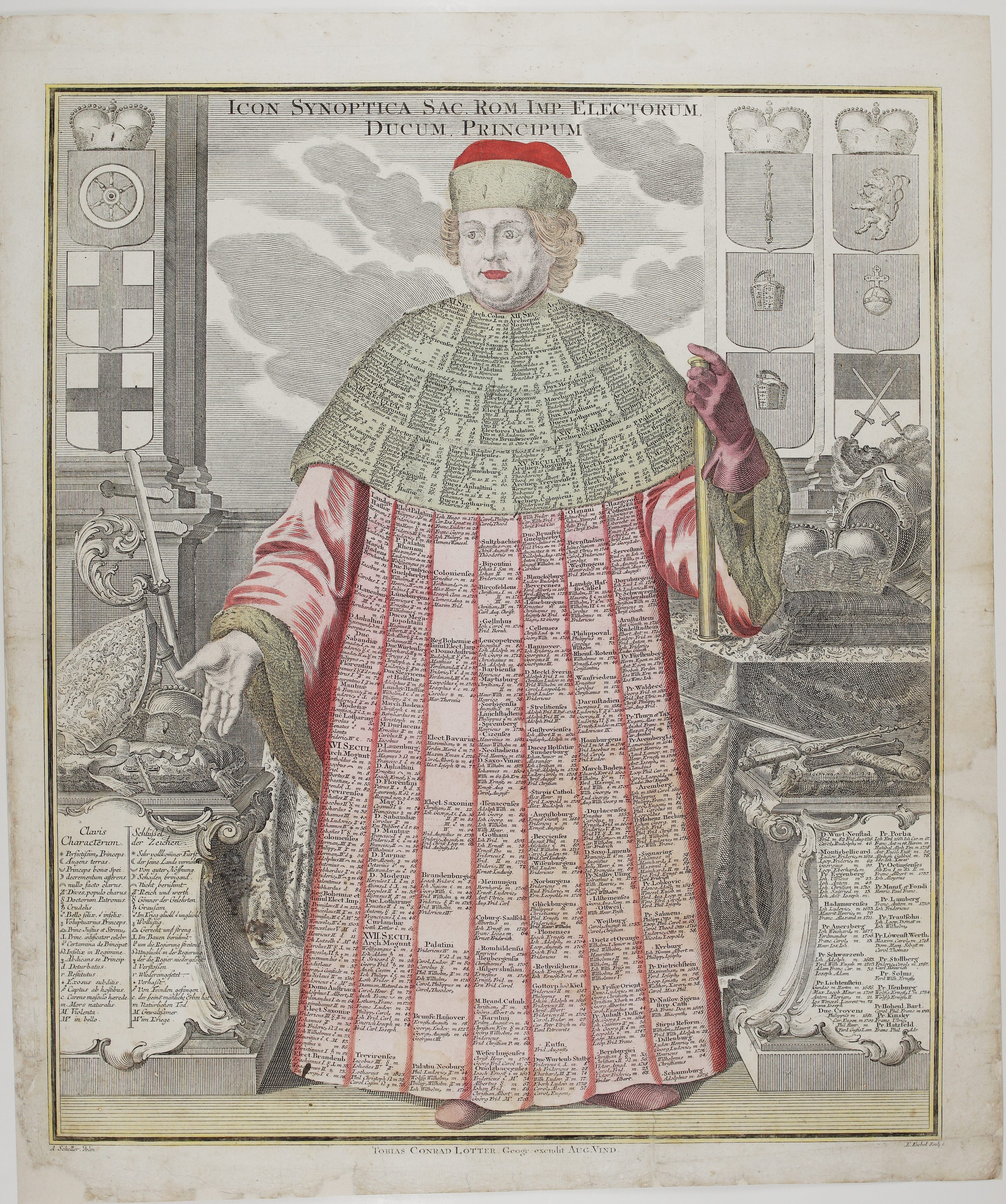
Title: “Icon Synoptica Sac. Rom. Imp. Electorum, Ducum, Principum”
Description:
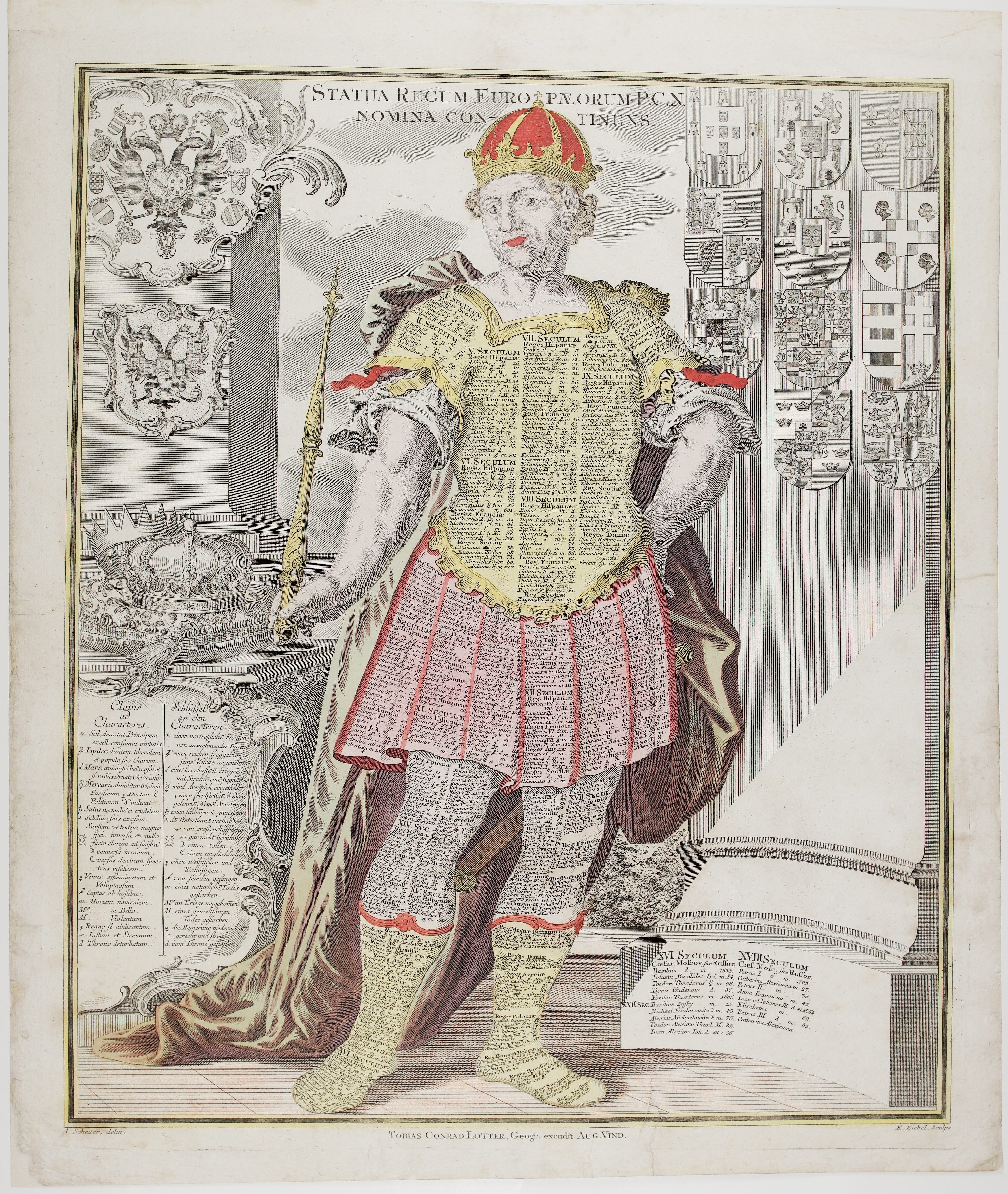
A large hand-colored copper engraving “Icones synopticae monarchorum, pontificum Romanorum, regum Europaeorum et Romani Imperii electorum ducum principum” (Synoptic images of monarchs, Roman pontiffs, kings of Europe, and prince-electors of the Holy Roman Empire).
The figure wears the red, ermine-banded Electoral cap (“Kurhut”) rather than a royal crown, and points with his right hand toward a baroque table bearing the papal tiara, imperial crown, and a bishop’s crozier — a deliberate visual pairing of spiritual and temporal authority reflecting the Empire’s medieval self-image as a joint undertaking of Pope and Emperor. His shoulder-cape, organized by century, lists the Empire’s ecclesiastical Electors (the Archbishop-Electors of Mainz, Trier, and Cologne) and the lay Electors of Saxony, the Palatinate, and Brandenburg. The skirt below breaks into dozens of narrow columns, each headed with a princely house and carrying its own dynastic line: the Electors of Bavaria and Hanover (both later additions to the Electoral college), the Kings of Bohemia “simul Elect. Imp. e Domo Austriae” (simultaneously Imperial Electors from the House of Austria, running through Rudolf II, Matthias, Ferdinand II, Ferdinand III, Leopold I, Joseph I, Charles VI, to Maria Theresa), the Dukes of Wolfenbüttel, Lüneburg, Mecklenburg-Schwerin, Saxe-Gotha and its cadet lines (Coburg-Saalfeld, Meiningen, Hildburghausen), the Landgraves of Hesse, the Houses of Savoy, Modena, Parma, and Mantua, and in the side panels, a further roster of lesser Imperial princes — Liechtenstein, Nassau-Siegen, Hohenlohe-Bartenstein, Salm, Solms, Auersperg, and more. The margins carry the heraldic insignia of the Electors’ hereditary court offices — Mainz’s wheel, a sword for Saxony’s Arch-Marshalship, an orb and scepter for the Arch-Treasurer and Arch-Chamberlain — flanking a crown and the chair of state at either side.
The design is credited by A. Scheller (“delin.”), engraved by E. Eichel (“sculps.”), and published by Tobias Conrad Lotter in Augsburg (“Geogr. excudit Aug. Vind.”).
T. C. Lotter married into and took over much of the output of Matthäus Seutter’s Augsburg firm, one of the leading German map and print houses of the 18th century; this same composition also circulated earlier under Seutter’s own imprint.
Designer: August Scheller (1719–1790)
Engraver: Emanuel Eichel (1717–1782)
Publisher: Tobias Conrad Lotter ( 1717 – 1777 )
Sheet size: 63,5 x 53,5 cm
Year: 1770
Technique: copper engraving
Condition:
Very good condition. Original, contemporary, hand coloring. Few marginal restorations.
This is an original antique map published in 1770 and not a modern copy or reprint
On your request I will provide a Certificate of Authenticity
In stock