1770 – T. C. Lotter – Colossus Monarchicus Statua Danielis
550 €
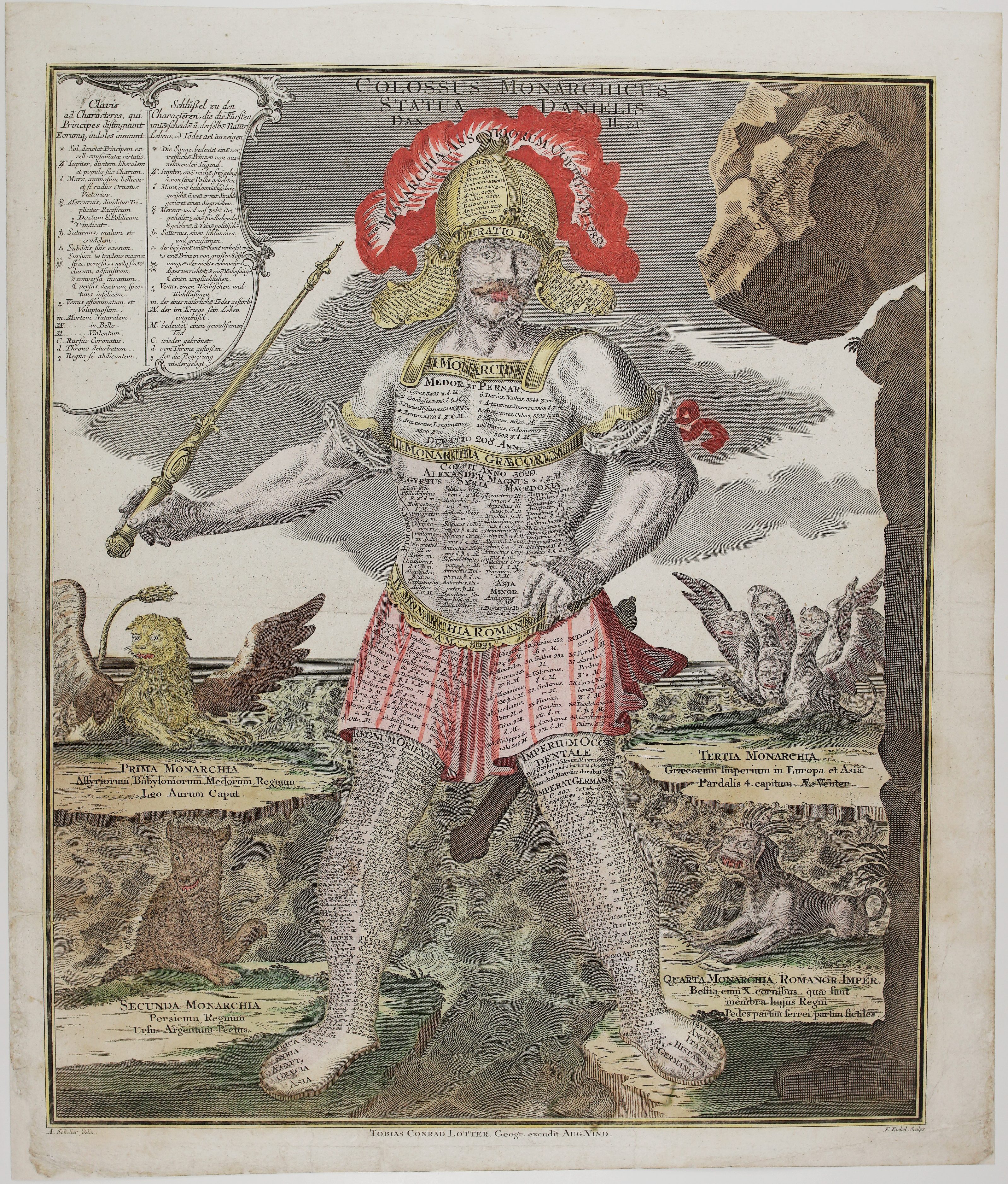
Title: “Colossus Monarchicus Statua Danielis. Dan. II. 31.”
Description:
A large hand-colored copper engraving illustrating the “Four Monarchies” of the Book of Daniel — the prophetic statue seen in Nebuchadnezzar’s dream (Daniel 2), its head of gold, chest and arms of silver, belly and thighs of bronze, legs of iron, and feet of iron mixed with clay, each identified with a successive world empire. Lotter’s workshop reimagines the dream-statue as a single armored colossus, inscribing the actual list of rulers of each empire directly onto the corresponding body part or armor segment, and pairs each monarchy with its corresponding beast from Daniel’s companion vision in chapter 7, shown crouched in the four corners of the composition.
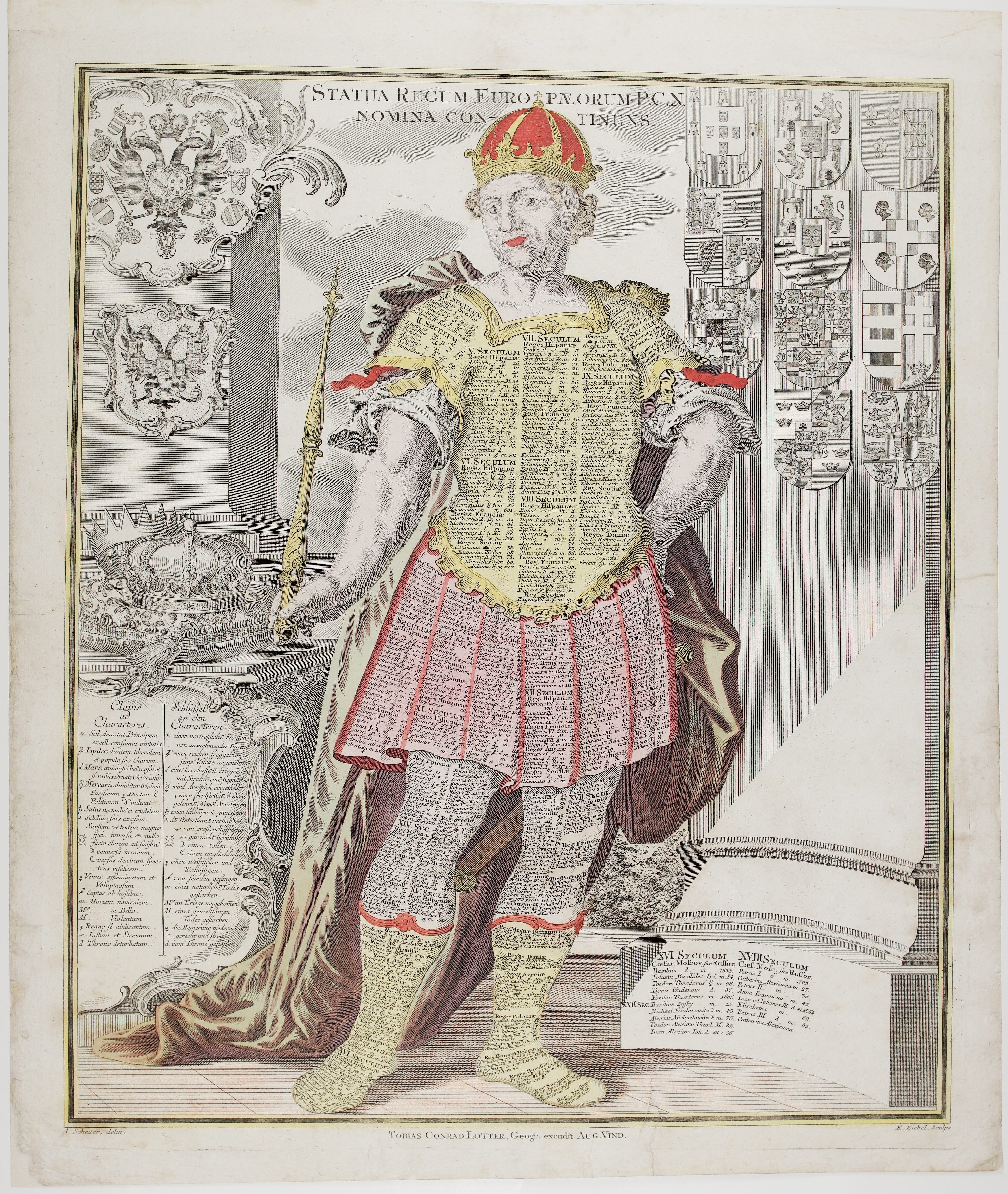
The helmet carries the First Monarchy — the Assyrian, Babylonian, and Median kings (Belus, Ninus, Semiramis, and successors, given a stated total duration of 1636 years) — captioned below as “Prima Monarchia… Leo, Aurum Caput” (Lion, golden head), illustrated by a winged lion. The breastplate carries the Second Monarchy, the Persian kings from Cyrus through Darius III Codomanus (duration 208 years), captioned “Secunda Monarchia… Ursus, Argentum Pectus” (Bear, silver chest), with a bear shown at lower left. The midsection carries the Third Monarchy, Alexander the Great’s empire split into its Hellenistic successor kingdoms — the Ptolemies of Egypt, Seleucids of Syria, Antigonids of Macedonia, and the rulers of Asia Minor, each given a full dynastic list — captioned “Tertia Monarchia… Pardalis quatuor capitum, Aes Venter” (Four-headed leopard, bronze belly), illustrated by a four-headed winged leopard at lower right. The legs and feet carry the Fourth Monarchy, Rome, split into “Regnum Orientale” (the Eastern Empire) on one leg and “Imperium Occidentale” (the Western Empire, continuing as the Holy Roman “Imperator Germaniae” from Charlemagne in 800, through to the “Domo Austriaca” — the House of Austria) on the other, captioned “Quarta Monarchia… Bestia cum X cornibus… Pedes partim ferrei partim fictiles” (the beast with ten horns, feet partly iron, partly clay), with a horned monster at lower right; the feet themselves are labeled with the fragmented territories of the post-Roman world — Africa, Syria, Egypt, Greece, and Asia on one foot, Gaul, England, Italy, Spain, and Germany on the other. A symbol-key at upper left (“Clavis ad Characteres” / “Schlüssel zu den Characteren”) decodes small planetary marks attached to individual rulers’ names, identical in system to the key used on Lotter’s companion “Statua Regum Europaeorum.”
The design is credited by A. Scheller (“delin.”), engraved by E. Eichel (“sculps.”), and published by Tobias Conrad Lotter in Augsburg (“Geogr. excudit Aug. Vind.”).
T. C. Lotter married into and took over much of the output of Matthäus Seutter’s Augsburg firm, one of the leading German map and print houses of the 18th century; this same composition also circulated earlier under Seutter’s own imprint.
Designer: August Scheller (delin.)
Engraver: Emanuel Eichel (sculps.)
Publisher: Tobias Conrad Lotter ( 1717 – 1777 )
Sheet size: 63,5 x 53,5 cm
Year: 1770
Technique: copper engraving
Condition:
Very good condition. Original, contemporary, hand coloring. Few marginal restorations.
This is an original antique map published in 1770 and not a modern copy or reprint
On your request I will provide a Certificate of Authenticity
In stock