1493 – H. Schedel – CCXIII
120 €
Titles: “CCXIII”
Description:
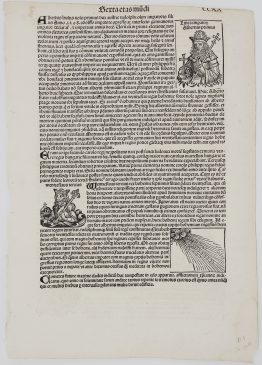
A leaf from Hartmann Schedel’s Latin edition of the “Liber chronicarum,” published in Nuremberg in 1493, packed with thirteenth-century drama: a martyred Dominican saint, one of medieval Italy’s most notorious tyrants, a pioneering biblical scholar, a disinherited king killed in battle, two popes, a canon lawyer, and a comet blamed for a pontiff’s death.
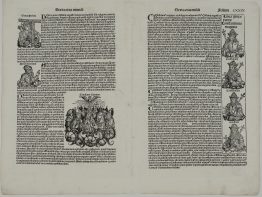
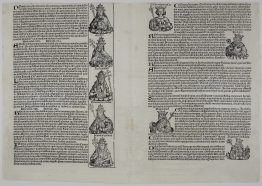
Folio CCXIII opens with St. Peter Martyr (“S. Petrus martyr ordinis predicator”), the Dominican inquisitor also known as Peter of Verona, shown with the blade of his own murder weapon — he was ambushed by Cathar sympathizers near Milan in 1252 and canonized within about a year of his death, one of the fastest canonizations of the medieval period. Beside him stands Ezzelino da Romano (“Etzelinus tyrannus”), the Ghibelline strongman who held much of the March of Treviso under a brutal, decades-long tyranny with the backing of Frederick II — the text recounts his mutilation of prisoners, his seizure of Verona, Vicenza, and Padua, and his death from wounds after defeat on the Adda in 1259. Hugh of Saint-Cher (“Hugo Cardinalis”), the Dominican Cardinal of Santa Sabina credited with one of the earliest concordances to the Bible, appears reading below. The lower register closes with Manfred of Sicily (“Manfredus rex”), Frederick II’s illegitimate son, whose defiance of successive popes and eventual defeat and death at the hands of Charles of Anjou — the campaign that also crushed the Florentine Guelphs at the Arbia — ended Hohenstaufen rule in southern Italy.
The verso continues under the heading “Linea summorum pontificum” with Urban IV (“Urbanus quartus”), the French pope of humble birth who instituted the feast of Corpus Christi and invited Charles of Anjou into Italy against Manfred, and Clement IV (“Clemens quartus,” formerly the lawyer and widower Guy Foulques), whose death triggered the longest papal vacancy in the Church’s history. Bernard of Compostela (“Bernardus Copostellanus doctor”), a canon lawyer linked to Innocent IV and author of a well-known “Apparatus” on the Decretals, is shown seated with a book. The page closes with the great comet of 1264 (“Cometa insignis”), visible for three months and, in this account, blamed for Urban IV’s fatal illness — illustrated with its own radiating woodcut.
Page number CCXIII
Worth knowing about the book itself: almost none of the portraits are individual likenesses — the same “generic ruler” and “generic pope” woodblocks get recycled again and again throughout the Chronicle for whichever figure is being discussed. And the red-ink initials and headings are rubrication, added by hand after printing, which is typical for surviving copies.
The Nuremberg Chronicles was the first printed history of the known world with about 2000 woodcuts the most picturesque work of the early time of printing. It became one of the most popular books of the 15th. century. The woodblock cutters were Michael Wolgemut, teacher of Albrecht Dürer and his stepson Wilhelm Pleydenwurff. The printing was carried out under the supervision of the great scholar-printer Anton Koberger.
Author: Hartmann Schedel (1440 – 1514)
Sheet size: 43,3 x 31,3 cm
Year: 1493
Technique: wood block
Condition:
In good condition.
This is an original antique map published in 1493 and NOT a modern copy or reprint
On your request I will provide a Certificate of Authenticity
In stock