1493 – H. Schedel – CCXIIII
120 €
Titles: “CCXIIII”
Description:
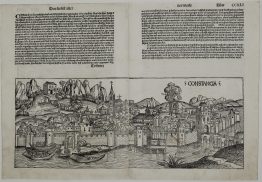
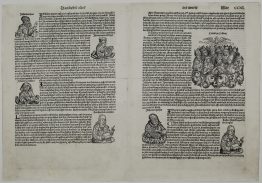
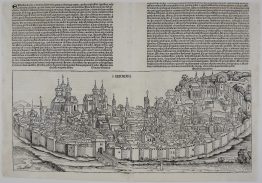
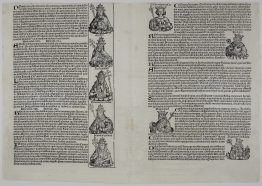
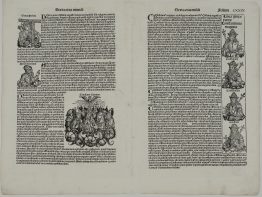
Very decorative woodcut from Hartmann Schedel’s the Latin edition of the “Liber chronicarum” published in 1493. This page comes from “Sexta etas mundi” (“The Sixth Age of the World”), the Chronicle’s long final section covering the birth of Christ up to the book’s own present day, told mostly through the reigns of popes and emperors.
Recto:
- Alphonsus and Richardus — this is the double election of 1257: Alfonso X of Castile and Richard of Cornwall (brother of Henry III of England) were both put forward as rival King of the Romans during the Great Interregnum that followed the Hohenstaufen collapse. Richard actually traveled to Germany and was crowned at Aachen; Alfonso never set foot there. The text notes that after Richard’s death, Alfonso eventually renounced his claim before Pope Gregory X — which is exactly the resolution that clears the way for Rudolph I’s election, the story you already saw play out on folio 216.
- An unheaded passage on Charles of Anjou’s coronation as King of Sicily (1266), crowned in Rome under papal authority since Sicily was held as a fief of the Church — this is the direct backstory to Charles II, whom you met on folio 218.
- The “mirabilis peregrinatio populorum” — a “wondrous pilgrimage of peoples” beginning in Perugia, with crowds (including, oddly, thousands of children) marked with crosses and processing between cities begging mercy and peace. This is the 1260 Flagellant movement (the “Great Devotion”), sparked partly by apocalyptic expectations tied to that year.
- Albertus Magnus — the Dominican “Doctor Universalis,” born at Lauingen on the Danube, briefly Bishop of Regensburg before resigning to teach at Cologne and Paris, commentator on all of Aristotle, author of De Animalibus, buried with great honor at Cologne.
- Bonaventure — born Giovanni di Fidanza at Bagnoregio, Franciscan Minister General and Cardinal Bishop of Albano, noted here as canonized by Sixtus IV in 1482.
Verso:
- Alexander of Hales — the “Doctor Irrefragabilis,” Paris-based Franciscan theologian, called “fons vitae” for his Summa.
- Guido Bonatus — the era’s most famous astrologer in the Latin West.
- Martinus Scotus — credited with a short chronicle called the “Martiniana.” Nicely, the text itself flags a dispute here: it says the Dominicans claim this same work for a bishop of their own order named Martin — almost certainly Martin of Opava (Martinus Polonus), whose Chronicon Pontificum et Imperatorum is the work usually known by that title. A rare moment where the Chronicle admits its own source confusion rather than papering over it.
- Alexander de Villa Dei — author of the Doctrinale, the standard versified Latin grammar textbook used in schools for centuries.
- Vincent of Beauvais (“Vincentius Gallus”) — Dominican encyclopedist behind the Speculum Maius, broken into Doctrinale, Morale, Naturale, and Historiale — the last of which he carried down to 1254.
- A passage on Florence reforming its government after Frederick II’s death, Genoese–Venetian discord originating from a dispute in the Levant (this lines up with the historical “War of Saint Sabas”), and Michael VIII Palaiologos recovering Constantinople from the Latins — ending the Latin Empire and restoring Greek rule (the Chronicle dates its eventual fall to the Ottomans to 1454, a year off from the 1453 you’ll see in most modern accounts).
- Hostiensis (Henry of Susa) and Goffredo da Trani, two of the period’s leading canon lawyers, plus Haymo of Faversham, the English Franciscan Minister General credited with revising the order’s breviary.
Page number CCXIIII
Worth knowing about the book itself: almost none of the portraits are individual likenesses — the same “generic ruler” and “generic pope” woodblocks get recycled again and again throughout the Chronicle for whichever figure is being discussed. And the red-ink initials and headings are rubrication, added by hand after printing, which is typical for surviving copies.
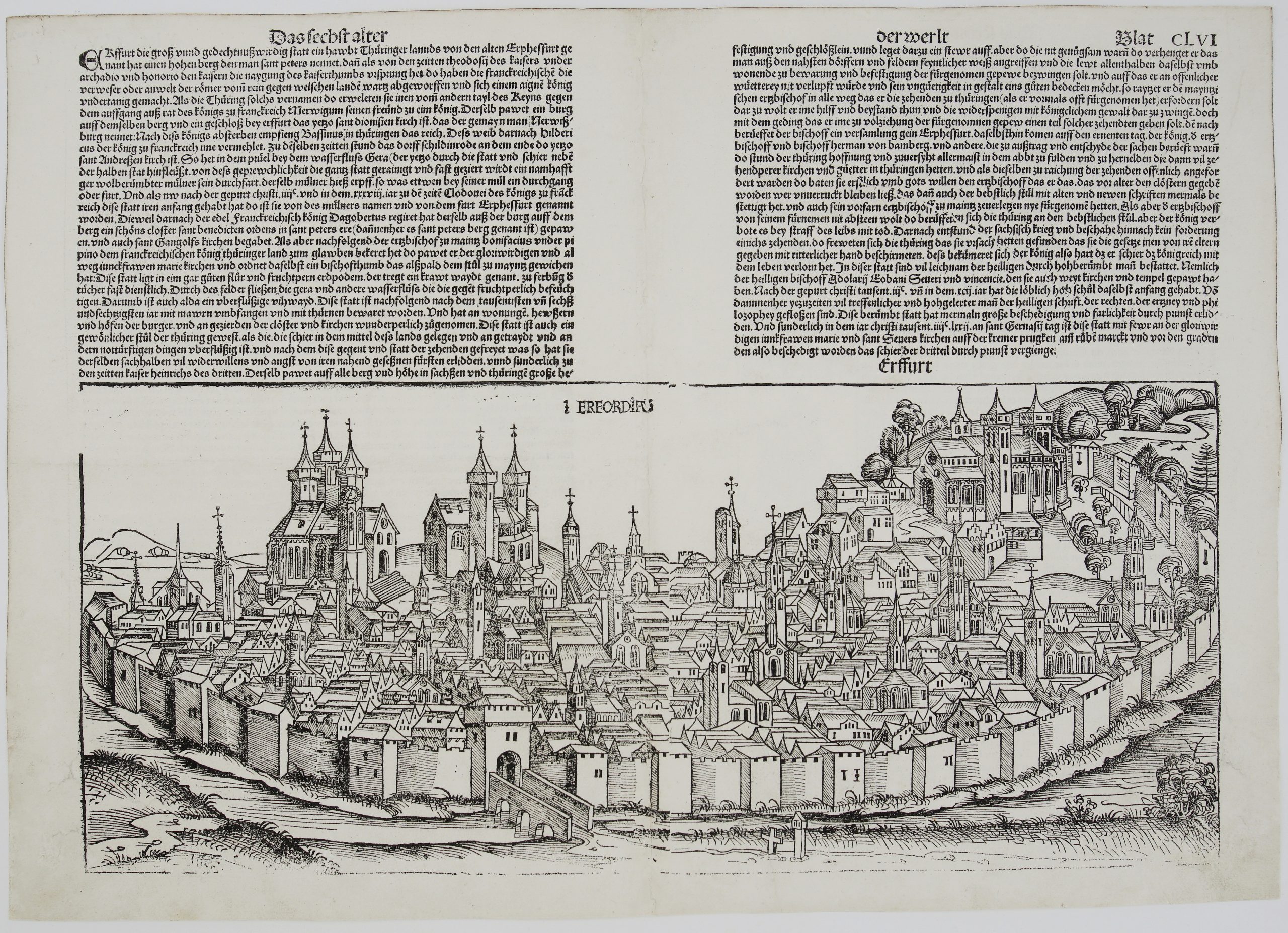
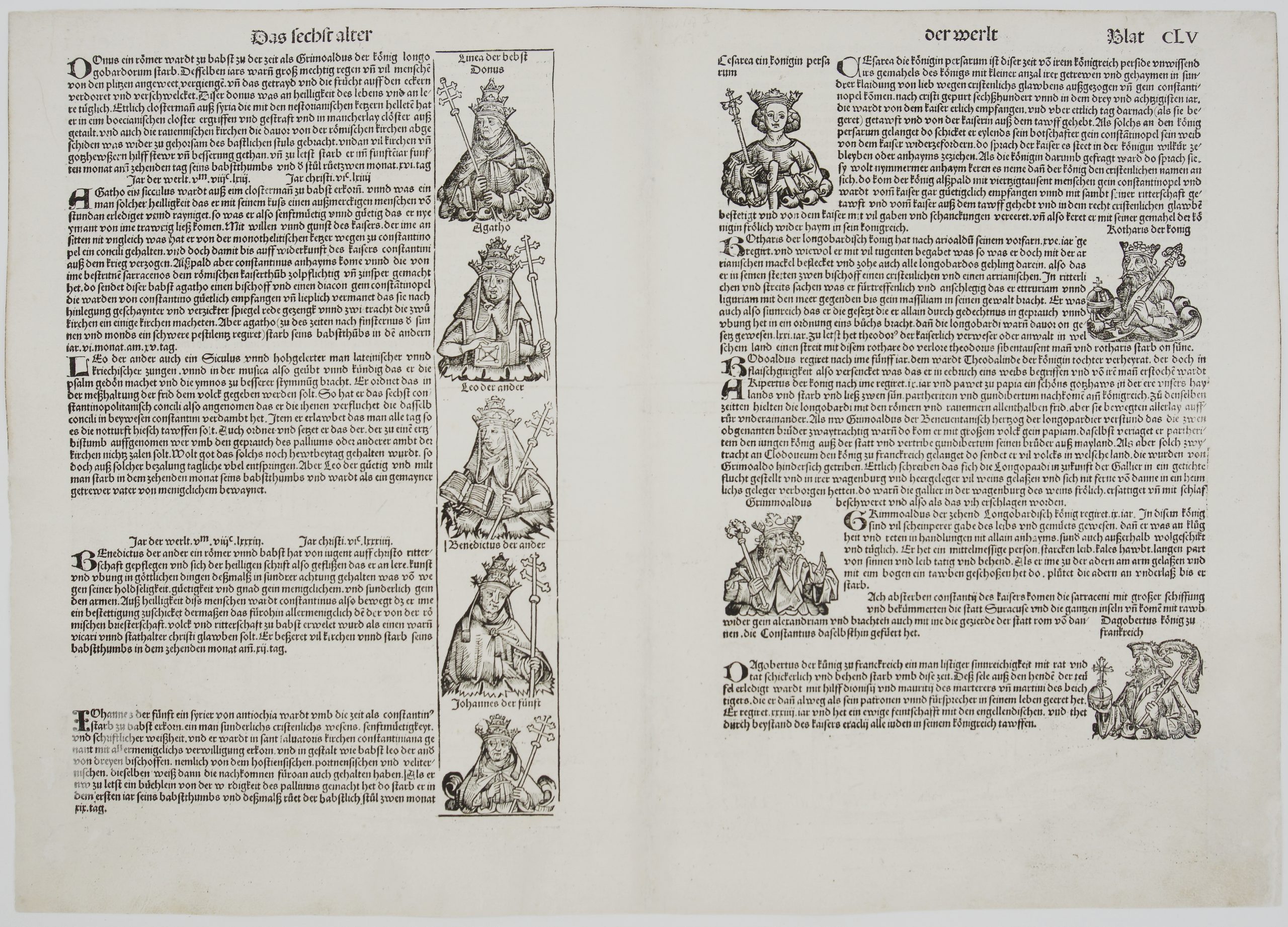
The Nuremberg Chronicles was the first printed history of the known world with about 2000 woodcuts the most picturesque work of the early time of printing. It became one of the most popular books of the 15th. century. The woodblock cutters were Michael Wolgemut, teacher of Albrecht Dürer and his stepson Wilhelm Pleydenwurff. The printing was carried out under the supervision of the great scholar-printer Anton Koberger.
Author: Hartmann Schedel (1440 – 1514)
Sheet size: 43,3 x 31,3 cm
Year: 1493
Technique: wood block
Condition:
In good condition, strong press on watermarked paper.
This is an original antique map published in 1493 and NOT a modern copy or reprint
On your request I will provide a Certificate of Authenticity
In stock