1493 – H. Schedel – CCXIX
150 €
Titles: “CCXIX”
Description:
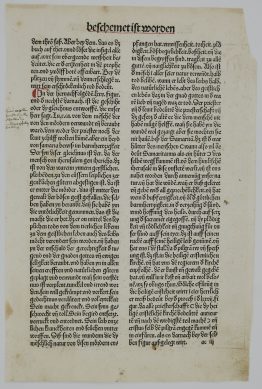
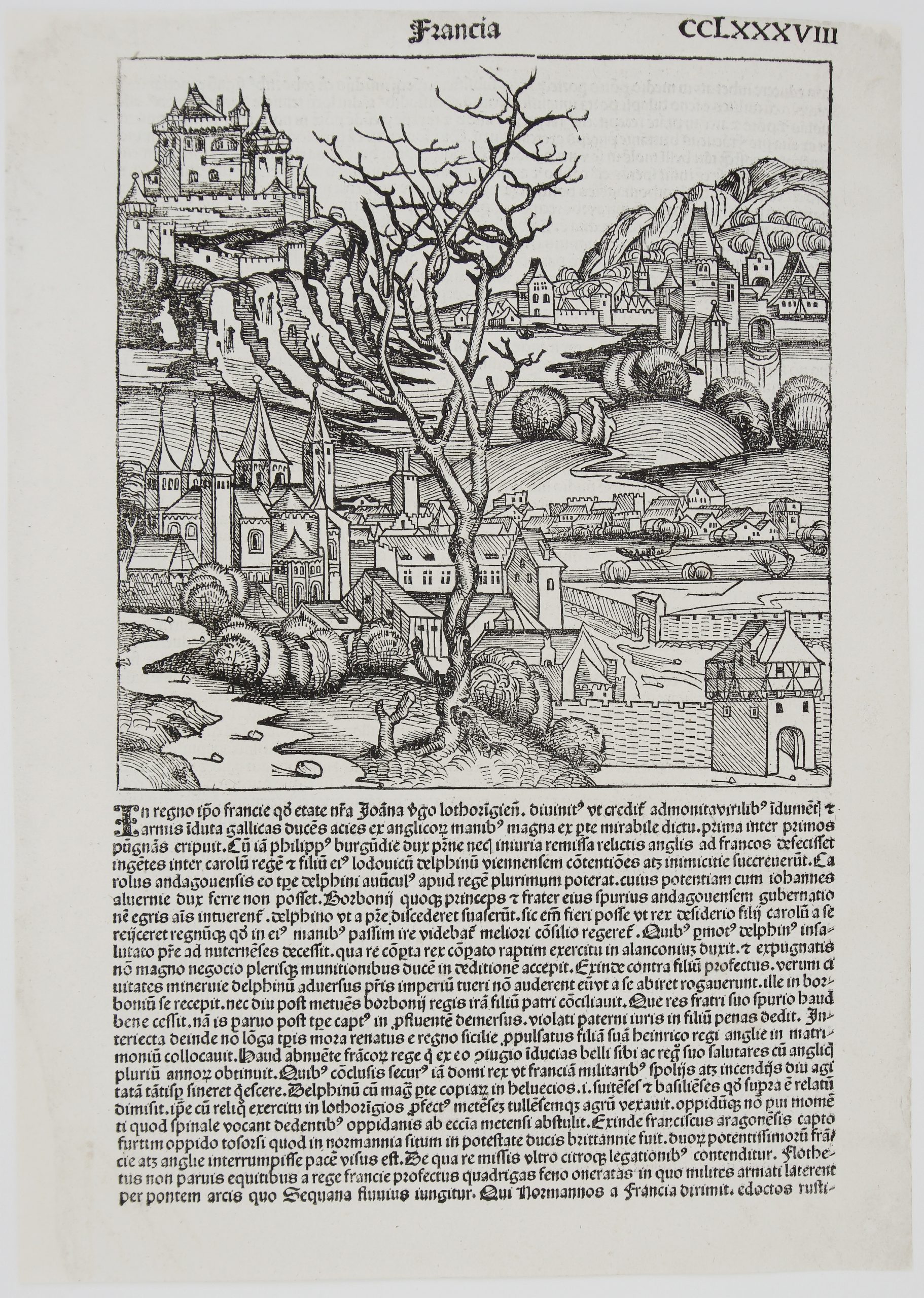
Very decorative woodcut from Hartmann Schedel’s the Latin edition of the “Liber chronicarum” published in 1493. This page comes from “Sexta etas mundi” (“The Sixth Age of the World”), the Chronicle’s long final section covering the birth of Christ up to the book’s own present day, told mostly through the reigns of popes and emperors.
Recto:
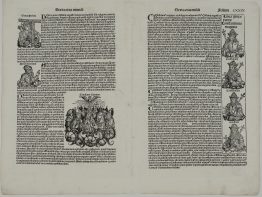
Adolf of Nassau — elected King of the Romans in 1292 after Rudolf of Habsburg’s death; described as valiant but never crowned by the pope. Covers his 1294 push into Meissen and a betrothal he brokered there with Wenceslas II of Bohemia, then his falling-out with the electors and his death in battle against Albert of Habsburg (Rudolf’s son) near Göllheim — the text pins it to the feast of Sts. Processus and Martinian, July 2, 1298.
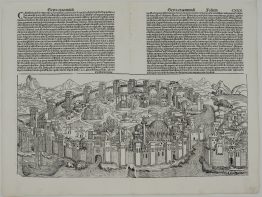
“De amissione locorum orientalium” (“On the loss of the eastern lands”) — the collapse of what remained of the Crusader states: Tripoli falls in 1289, then Tyre, Sidon, and Beirut, ending with the siege and sack of Acre (given its ancient name, “Ptolomaida”) in 1291.
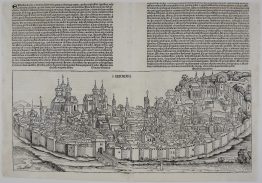
Ordo Celestinorum — the Celestine order, founded under Benedictine rule by the future Pope Celestine V, shown with the stock woodcut of a walled monastery.
Ordo Servorum — opens an entry on the Servite order, crediting Philip (Benizi) as its great early figure, active near Florence.
Verso:
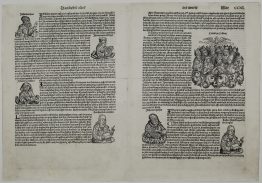
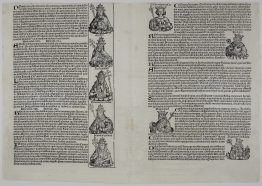
Pope Boniface VIII — born Benedetto Caetani, elected at Naples on Christmas Eve 1294. Covers his feud with the Colonna cardinals, the Jubilee/Holy Year of 1300, his clash with Philip IV of France, and ends with the “Outrage of Anagni”: Sciarra Colonna and Guillaume de Nogaret breaking into his family home by night and seizing him. He died a few weeks later and was buried in a chapel he’d built for himself at St. Peter’s.
Pope Benedict XI — the Dominican Niccolò Boccasini of Treviso, who tried to make peace with the Colonna and died within the year (1304), leaving the papacy vacant for eleven months before Clement V’s election.
A note that Boniface VIII, in these same years, issued the Liber Sextus — his compilation of canon law, made required reading in the universities.
St. Louis of Toulouse — son of Charles II of Naples, sent as a boy hostage to Aragon, educated by Franciscans, made a friar and then Bishop of Toulouse at Boniface’s request, dead at 23 in 1297. The bishop woodcut with crozier and book at lower left is his portrait.
Page number CCXIX
Worth knowing about the book itself: almost none of the portraits are individual likenesses — the same “generic ruler” and “generic pope” woodblocks get recycled again and again throughout the Chronicle for whichever figure is being discussed. And the red-ink initials and headings are rubrication, added by hand after printing, which is typical for surviving copies.
The Nuremberg Chronicles was the first printed history of the known world with about 2000 woodcuts the most picturesque work of the early time of printing. It became one of the most popular books of the 15th. century. The woodblock cutters were Michael Wolgemut, teacher of Albrecht Dürer and his stepson Wilhelm Pleydenwurff. The printing was carried out under the supervision of the great scholar-printer Anton Koberger.
Author: Hartmann Schedel (1440 – 1514)
Sheet size: 43,3 x 31,3 cm
Year: 1493
Technique: wood block
Condition:
In good condition, strong press on watermarked paper.
This is an original antique map published in 1493 and NOT a modern copy or reprint
On your request I will provide a Certificate of Authenticity
In stock