1493 – H. Schedel – Emperor Frederick II
200 €
Page number: CCIX
Description:
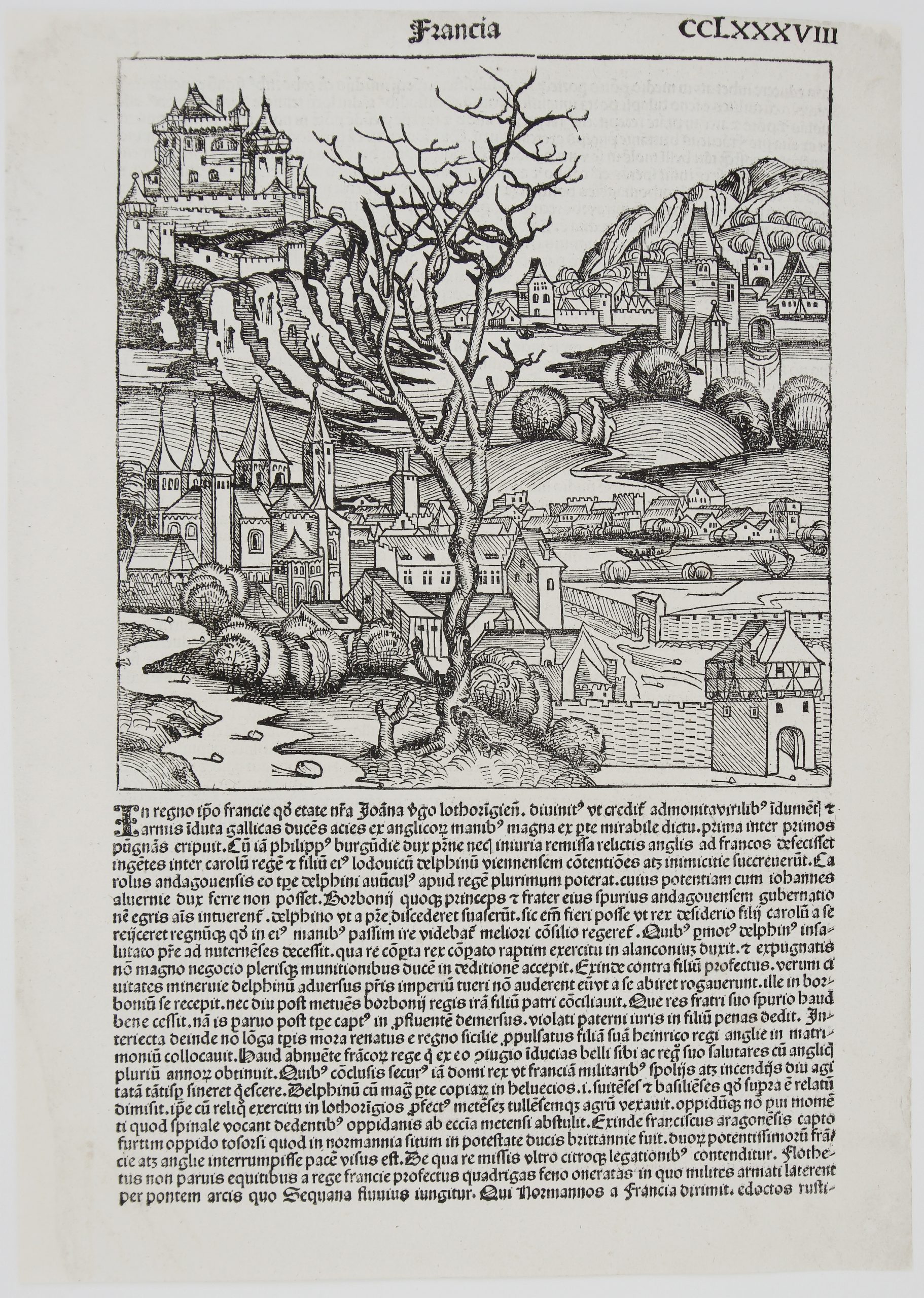
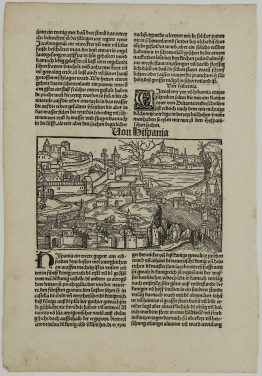
An original leaf from the first, Latin edition of Hartmann Schedel’s “Liber Chronicarum”, the famous Nuremberg Chronicle, printed in Nuremberg by Anton Koberger on 12 July 1493. The Chronicle is the most lavishly illustrated book of the 15th century, with 1,809 woodcut illustrations printed from 645 blocks. They were made in the workshop of Michael Wolgemut, the teacher of the young Albrecht Dürer, and his stepson Wilhelm Pleydenwurff. Folio CCIX belongs to the “Sixth Age of the World” and covers the first half of the 13th century.
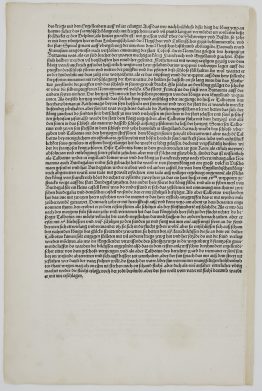
Recto (Folium CCIX). A full-length woodcut portrait headed “Linea imperatorum – Fridericus secundus” shows Emperor Frederick II, crowned, with sceptre and orb, in a richly patterned robe. The text tells the life of this extraordinary ruler, the “wonder of the world”:
- Birth: born to the Empress Constance in public, so that no one could doubt his royal birth.
- Election and learning: elected emperor in place of Otto IV and crowned by Pope Honorius III. He was a strong soldier, fluent in Latin, Italian, Greek, French and Arabic, and built palaces and castles across Sicily and Apulia.
- Conflict with the papacy: the crusade from Brindisi, the struggle with the popes, and the wars of the Guelphs and Ghibellines. Pope Innocent IV finally excommunicated and deposed him, and he was defeated at Parma.
- Death and epitaph: Schedel gives the rumour that his son Manfred poisoned or smothered him, and quotes his epitaph: “If probity, wisdom, grace, wealth and noble birth could resist death, Frederick who lies here would not be dead”.
At the foot of the page, a woodcut of a darkened sun with a human face illustrates the great solar eclipse, “so deep that people thought night had come” and turned to penance. Astrologers read it as a sign of the death of Pope Gregory IX, and Schedel adds that such judgements are “mostly deceptive”. The text also records great earthquakes, and a flood in which the sea nearly swallowed the whole of Frisia, drowning a hundred thousand people.
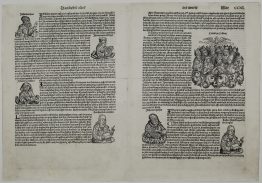
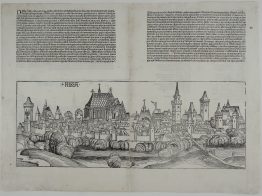
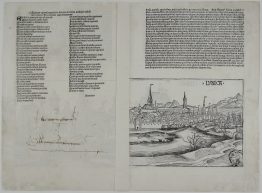
Verso. Two large town-and-church woodcuts illustrate the founding of the two great mendicant orders:
- “Ordo predicatorum” (the Dominicans): St Dominic is introduced as “a new star”. The text tells how Pope Innocent III dreamt that the Lateran basilica was collapsing and saw Dominic holding it up on his shoulders, and how the order was confirmed by Honorius III. It names its great men: St Thomas Aquinas, St Peter Martyr, St Vincent Ferrer, Albertus Magnus, Jacobus de Voragine, St Antoninus of Florence, and the Dominican popes Innocent V and Benedict XI.
- “Ordo minorum” (the Franciscans): St Francis and his rule of poverty, chastity and obedience, confirmed by Pope Honorius. Among its members are St Anthony of Padua, St Bonaventure and St Bernardino of Siena, and Popes Nicholas IV, Alexander V and Sixtus IV.
The page ends with two events of the years around 1220. First, the “Tartars”, a Scythian people, laid waste to Georgia and Greater Armenia, then crossed the mountains and broke into Poland and Hungary with fire and slaughter. Second, Jerusalem was destroyed by Saladin’s heir “Coradinus”, who spared only the Temple and was persuaded by the Christians not to desecrate the Holy Sepulchre.
A rich leaf combining the most famous emperor of the Middle Ages with an eclipse, the founding of the Dominicans and Franciscans, and the Mongol invasion of Poland and Hungary.
Artist: Hartmann Schedel (1440 – 1514)
Publisher: Anton Koberger
Sheet size: 31,4 x 45,3 cm
Year: 1493
Technique: wood block
Condition:
In very good condition. Watermarked paper.
This is an original antique map published in 1493 and NOT a modern copy or reprint
On your request I will provide a Certificate of Authenticity
In stock