- You cannot add that amount to the cart — we have 1 in stock and you already have 1 in your cart. View cart
1620 – H. Holland – Gulielmus Perkinsus
50 €
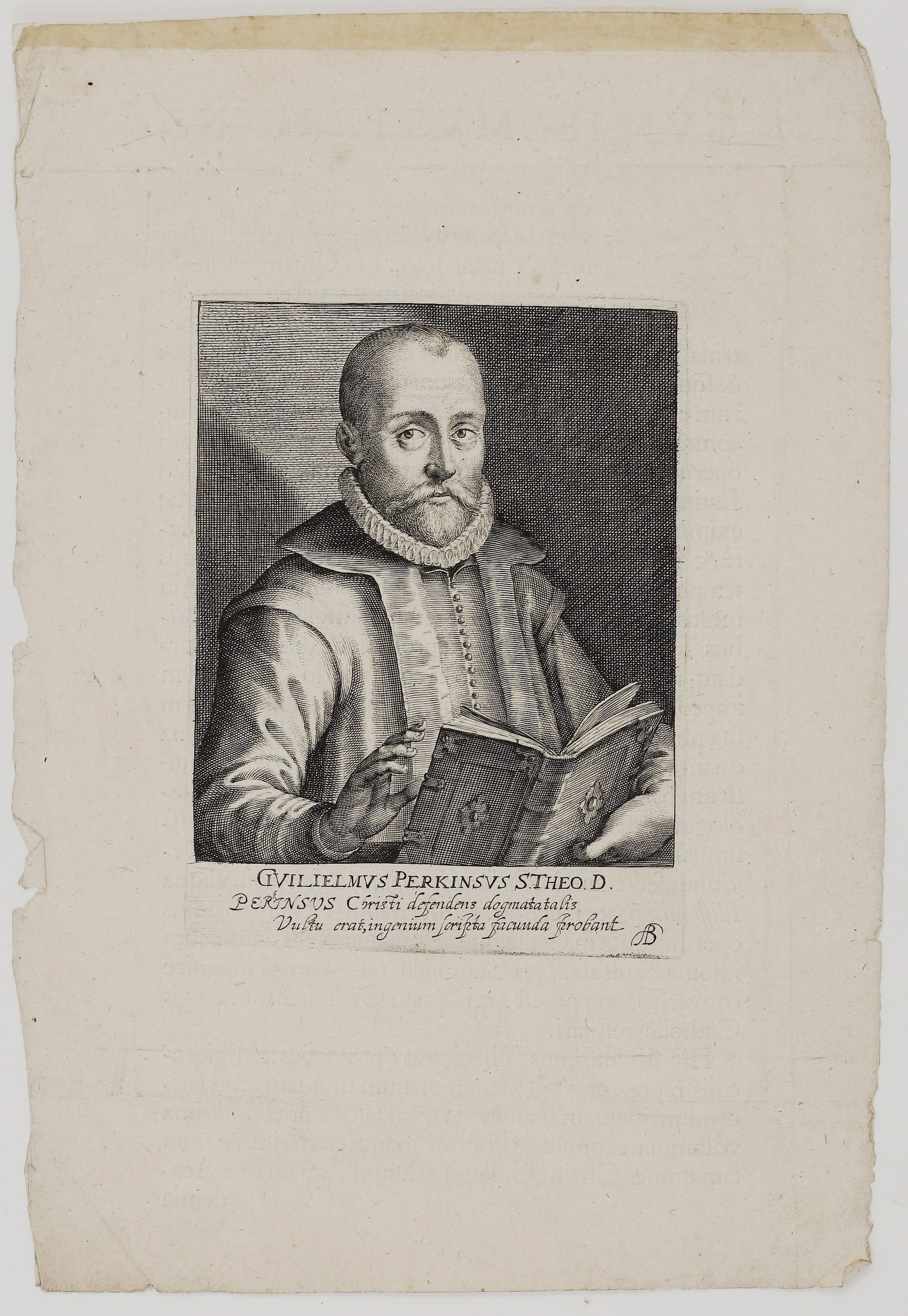
Title: Gulielmus Perkinsus S. Theo. D.
William Perkins, Doctor of Theology
Description:
This is a fine early 17th-century copper-engraved portrait of William Perkins (1558–1602), Fellow of Christ’s College, Cambridge. He was the most influential Puritan theologian of Elizabethan England, and his writings were translated across Protestant Europe.
It comes from Henry Holland’s Herωologia Anglica, the first great series of English portraits. The book was published in 1620 in Arnhem by Jan Jansson at the expense of Crispijn van de Passe, with portraits engraved by Willem and Magdalena van de Passe. Perkins is shown half-length in gown and ruff, holding an open book, above a Latin couplet on his learning and doctrine. There is a monogram in the plate at lower right.
On the verso is the letterpress page 220, the opening of Holland’s Latin life of Perkins, beginning with a large decorative woodcut initial. Holland, himself a native of Warwickshire, tells how Perkins:
- was born at Marston near Coventry, “my own sweet native soil”
- was educated at Christ’s College, Cambridge, and became a tireless preacher and author
- wrote works that were translated into Latin, French, German and Dutch and printed abroad, spreading his fame through Britain, France, Germany, the Low Countries and even Spain
He also notes that his Reformed Catholic had been translated into Spanish. Holland adds a striking detail that explains the portrait: Perkins’s right hand was maimed and useless for writing, so he wrote all his many volumes with his left hand.
Cartographer/Artist: Henry Holland
Publisher: Crispijn van de Passe and Jan Jansson, Arnhem
Engraver: Willem and Magdalena van de Passe
Book: Henry Holland, Herωologia Anglica
Sheet size: 29.0 x 19.3 cm
Year: 1620
Technique: copper engraving
Reference: Hind, Engraving in England II, no. 64
Condition:
A single sheet with a strong impression. The paper is toned, with a brown strip along the upper edge from an old mount and a few faint spots. The right edge is uneven and frayed, with small chips. The verso text shows through lightly, and the engraved image is clean.
This is an original antique engraving published in 1620 and NOT a modern copy or reprint
On your request I will provide a Certificate of Authenticity
In stock