1493 – H. Schedel – Frederick Barbarossa
200 €
Page number: CCIII
Description:
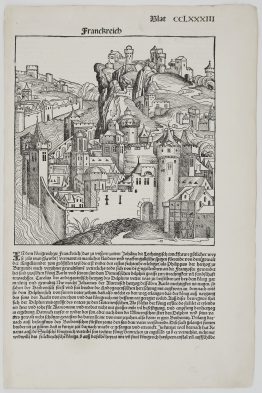
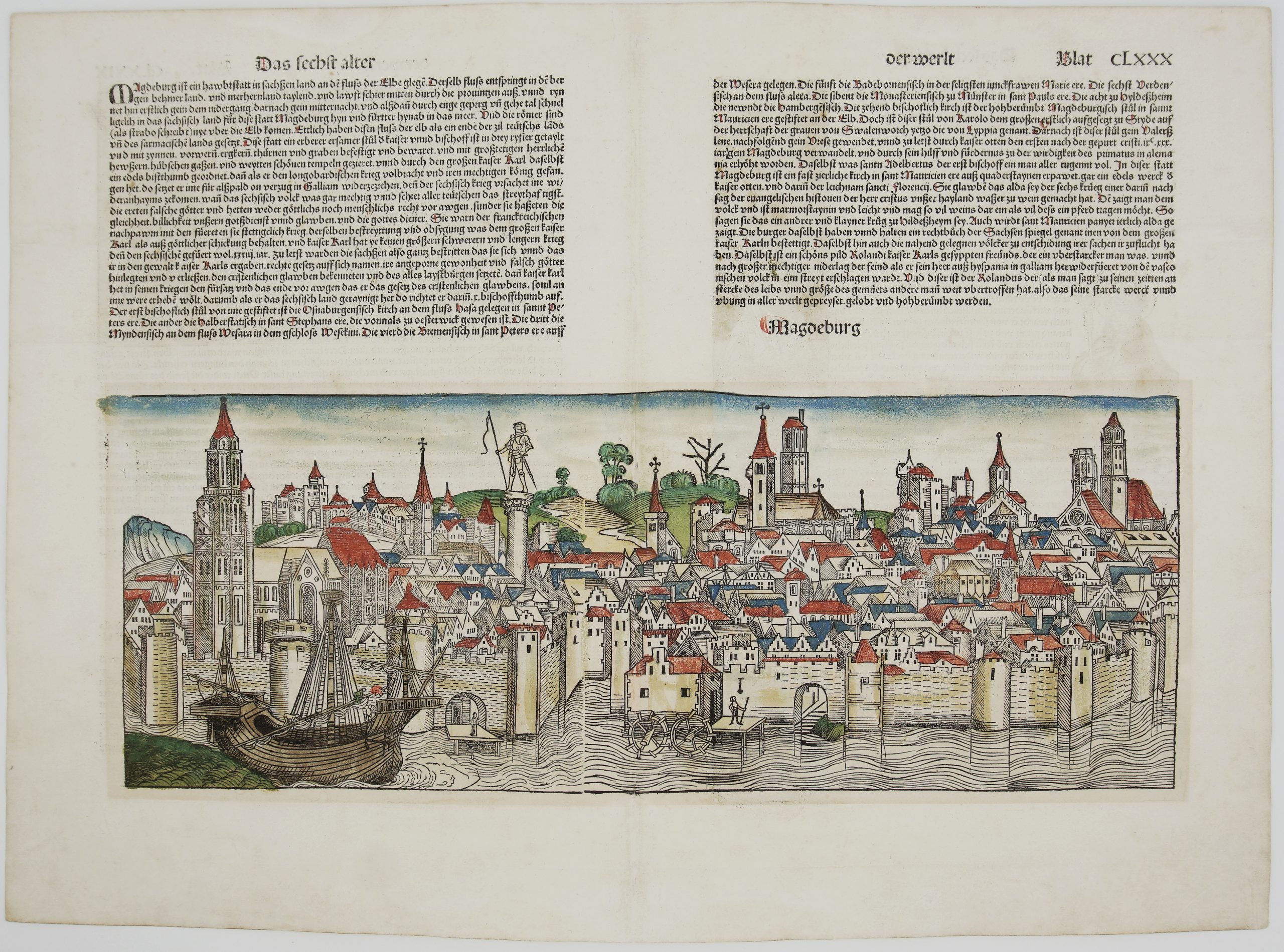
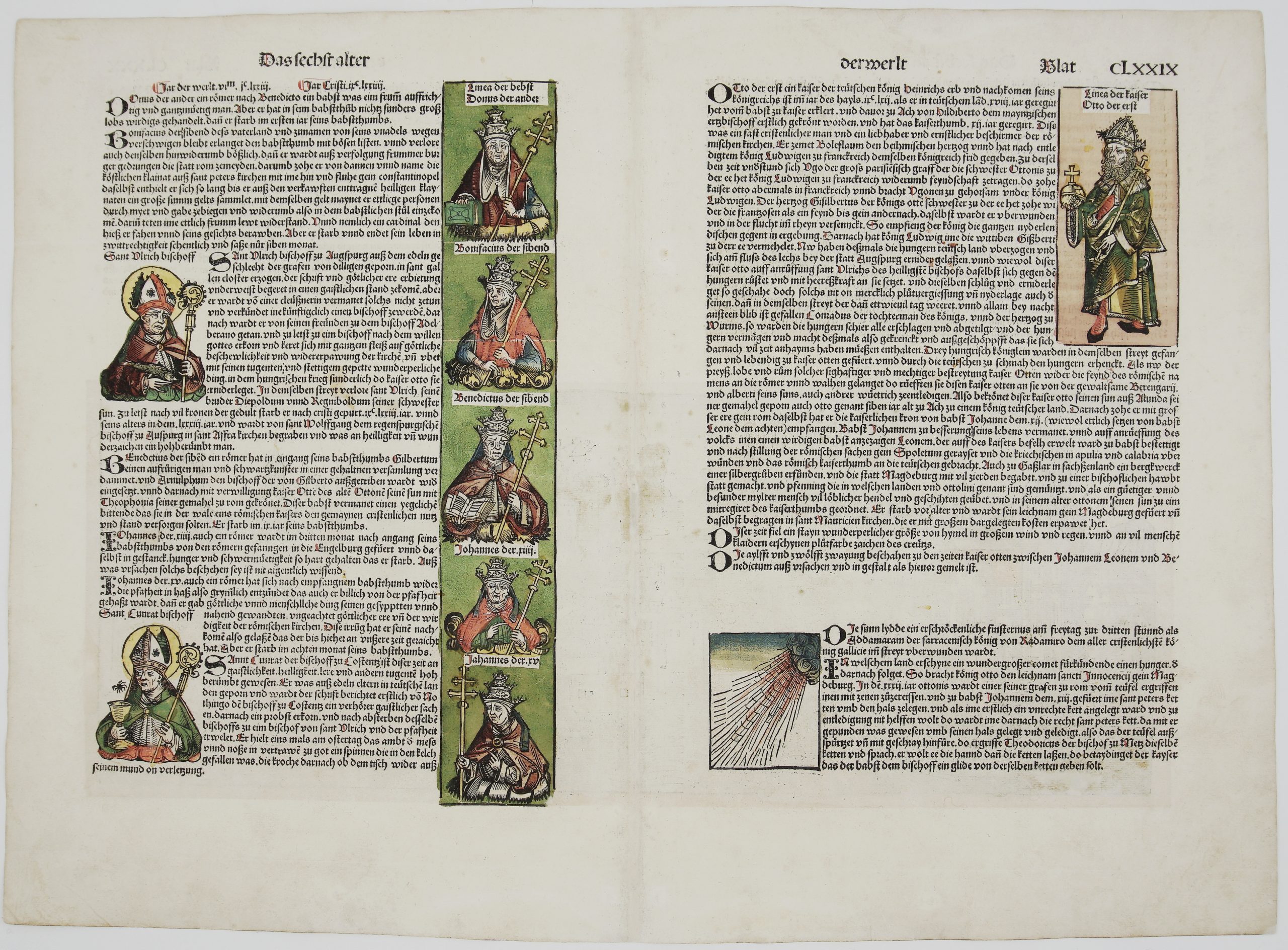
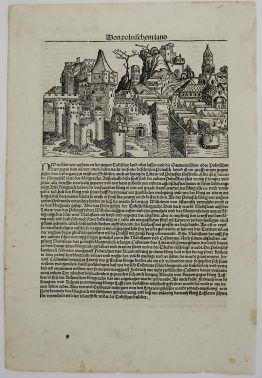
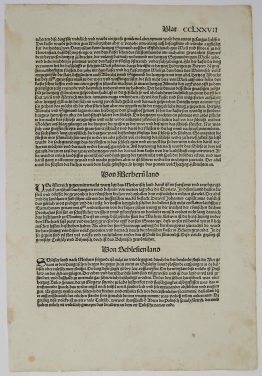
An original leaf from the first, Latin edition of Hartmann Schedel’s “Liber Chronicarum”, the famous Nuremberg Chronicle, printed in Nuremberg by Anton Koberger on 12 July 1493. The Chronicle is the most lavishly illustrated book of the 15th century, with 1,809 woodcut illustrations printed from 645 blocks. They were made in the workshop of Michael Wolgemut, the teacher of the young Albrecht Dürer, and his stepson Wilhelm Pleydenwurff. Folio CCIII belongs to the “Sixth Age of the World” and covers the second half of the 12th century.
Recto (CCIII). A tall, full-length woodcut portrait of Emperor Frederick I Barbarossa, headed “Linea imperatorum – Fridericus primus”, shows him crowned and robed with sceptre and orb. The text tells his life:
- Election and coronation: a Swabian prince of the house of the Staufen, elected king at Frankfurt and crowned emperor in Rome by Pope Adrian IV.
- The Italian wars: his campaigns in northern Italy, including the sieges of Tortona and Milan, which he razed to the ground.
- The struggle with Pope Alexander III: the long conflict that ended with their reconciliation in Venice, and the privileges the grateful Pope granted to the Doge Sebastiano Ziani and the Venetians.
- The Third Crusade: Barbarossa led a great army through Hungary and Bulgaria to Constantinople, took Philomelium and Iconium (Konya), and drowned while bathing in a fast-flowing river in Lesser Armenia, “cutting off the great hope of the Christians” (1190).
The page ends with the beginning of the Waldensian movement. Its founder, Waldo, a rich citizen of Lyon, gave away his wealth to the poor and preached evangelical poverty. Schedel condemns it as a heresy and notes that “this folly still flourishes in many places”.
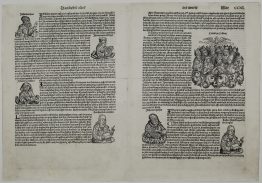
Verso.
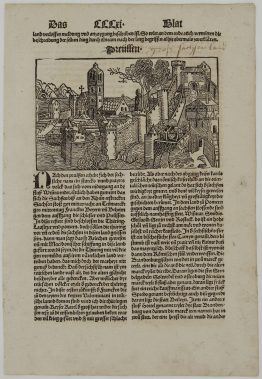
- The Augustinian Hermits. A large woodcut headed “Ordo heremitarum sancti Augustini” shows a walled monastery church with a gatehouse, illustrating the Order of the Hermits of St Augustine. The text tells of William the Hermit, Duke of Aquitaine and Count of Poitou, who renounced the world and founded an order of hermits, later united with the Augustinian Hermits.
- Portents in the sky. Two striking woodcuts of heavenly signs: a sun marked with a cross between two crescent moons with human faces, and a blazing sun with a face. The text reports that three suns were seen together in the west on the 5th of September, and later three moons with the sign of the cross between them. These were taken as omens of the schism, when cardinals and princes split over the election of Pope Alexander III. Great earthquakes in Syria and Cilicia destroyed many towns at the same time.
- “Jo. mesue medicus”. A portrait of the physician Johannes Mesue examining a urine flask, the classic image of medieval diagnosis. The text describes his medical writings, including the “Antidotarium” and the “Canones universales”, and his unfinished book on diseases of the heart, completed by Pietro d’Abano of Padua.
- “Jo. carnotensis episcopus”. John of Salisbury, Bishop of Chartres and close friend of St Thomas Becket, author of the “Policraticus” and a life of Becket.
A rich and varied leaf, combining one of the great medieval emperors with celestial portents, medicine and church history.
Artist: Hartmann Schedel (1440 – 1514)
Publisher: Anton Koberger
Sheet size: 31,4 x 45,3 cm
Year: 1493
Technique: wood block
Condition:
In very good condition. Watermarked paper.
This is an original antique map published in 1493 and NOT a modern copy or reprint
On your request I will provide a Certificate of Authenticity
In stock