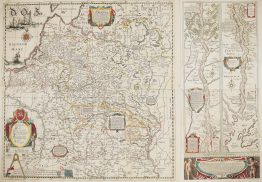
1559 – S. Munster – Typus Orbis Universalis
1,800 €
Title: “Typus Orbis Universalis”
(Map of the whole world)
Description:
This is one of the best-known world maps of the 16th century, from Sebastian Münster’s Cosmographia, the most widely read geography of its time. It comes from the Latin edition published in Basel by Heinrich Petri in 1559.
Münster first published the design in 1540. This impression is from the second, re-cut woodblock, which first appeared in 1550. It is signed with the initials “DK” of David Kandel in the lower left. The new block has a much richer border, with the world set in an oval among billowing clouds. Twelve wind heads blow from all sides, each named on a scroll, from Septentrio in the north to Zephyrus in the west. A sailing ship and several sea monsters swim in the oceans.
The map shows the world as Europeans pictured it in the decades after Columbus:
- North America: a long strip labelled “Terra Florida”, with “Corterati” in the north, named after the Portuguese explorers the Corte-Real brothers. Its shape still reflects Verrazzano’s belief in 1524 that he had glimpsed the Pacific across a narrow neck of land.
- South America: “America vel Brasilii insula”, with the Strait of Magellan cutting it off from a small fragment of the unknown southern land.
- The Pacific: the map design was the first to name it “Mare Pacificum”. The Americas continue around the edge of the oval, so Temistitan (Mexico City) reappears on the far right.
- Asia: Cathay (China), India, Calicut, Taprobana (Sri Lanka), Java, Borneo and Zipangri (Japan).
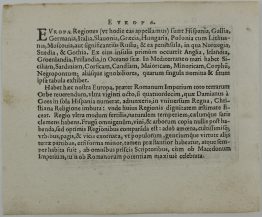
On the back, in large type, is Münster’s Latin introduction. It explains that the map shows where the land rises out of the waters, how Europe, Africa and Asia are divided, and where to place “those new islands found in our age in the Ocean, which they call the New World”.
Sebastian Münster (1488–1552), Hebrew scholar and cosmographer in Basel, first published the Cosmographia in German in 1544. It went through dozens of editions in several languages over the next century.
Cartographer: Sebastian Munster (1488 – 1552)
Block cutter: David Kandel (DK)
Leaf size: 30,8 x 39,3 cm
Year: 1559
Technique: woodcut
Reference: Shirley, The Mapping of the World, no. 92
Condition:
Good for such an early map. Strong impression. Centrefold reinforced on verso, with small restorations in the left and right margins. Light toning.
This is an original antique map published in 1559 and NOT a modern copy or reprint
On your request I will provide a Certificate of Authenticity
In stock