1493 – H. Schedel – De Regno Polonie
350 €
Title: “De Sarmatia regione Europe”
Description:
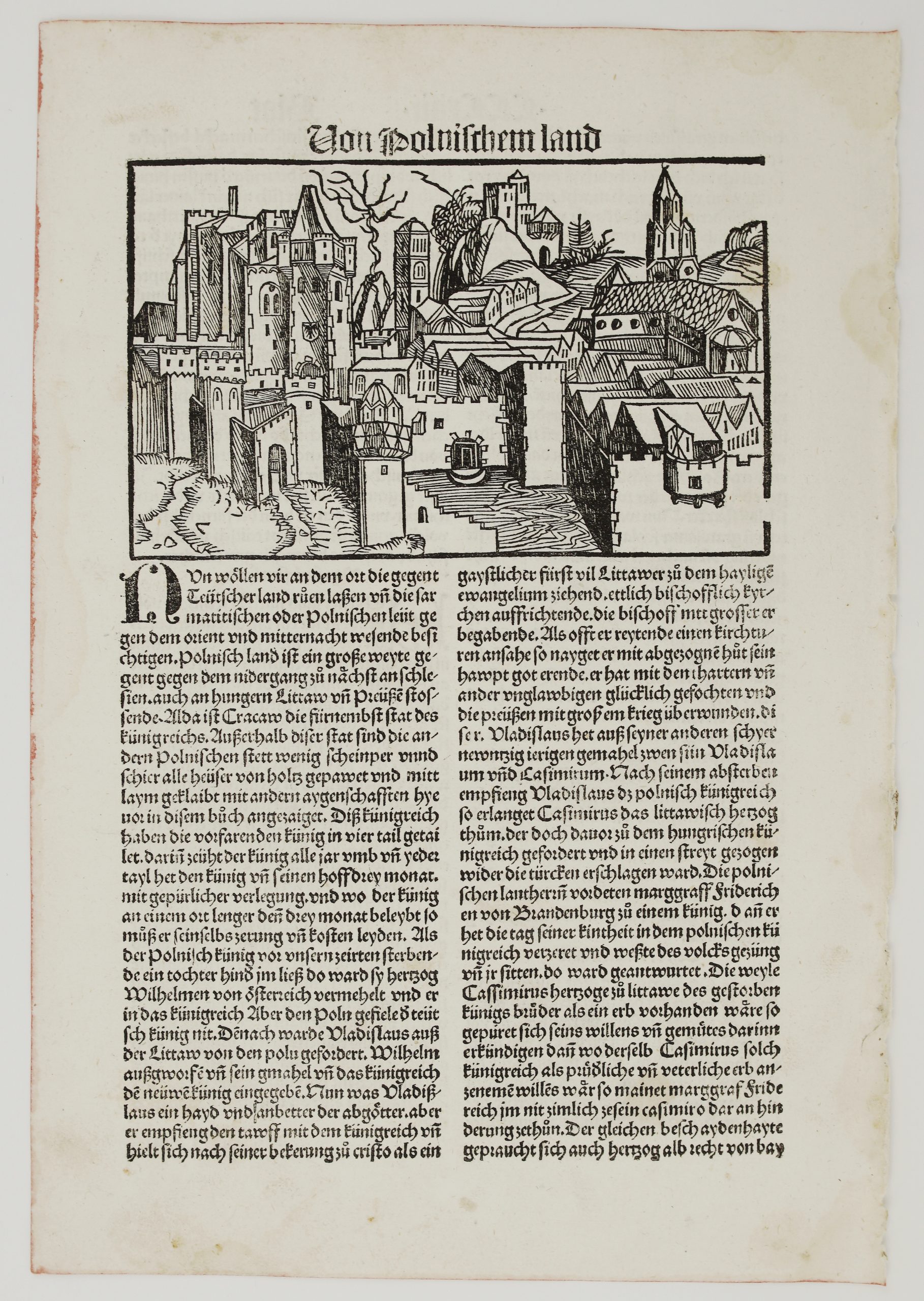
An original leaf from the first, Latin edition of Hartmann Schedel’s Liber Chronicarum, the famous Nuremberg Chronicle, printed in Nuremberg by Anton Koberger on 12 July 1493. It is an incunable, a book printed before 1501. The leaf belongs to the section on Sarmatia, Schedel’s name for the Kingdom of Poland and the Jagiellonian lands, Lithuania among them. That section is printed on unnumbered leaves near the end of the book.
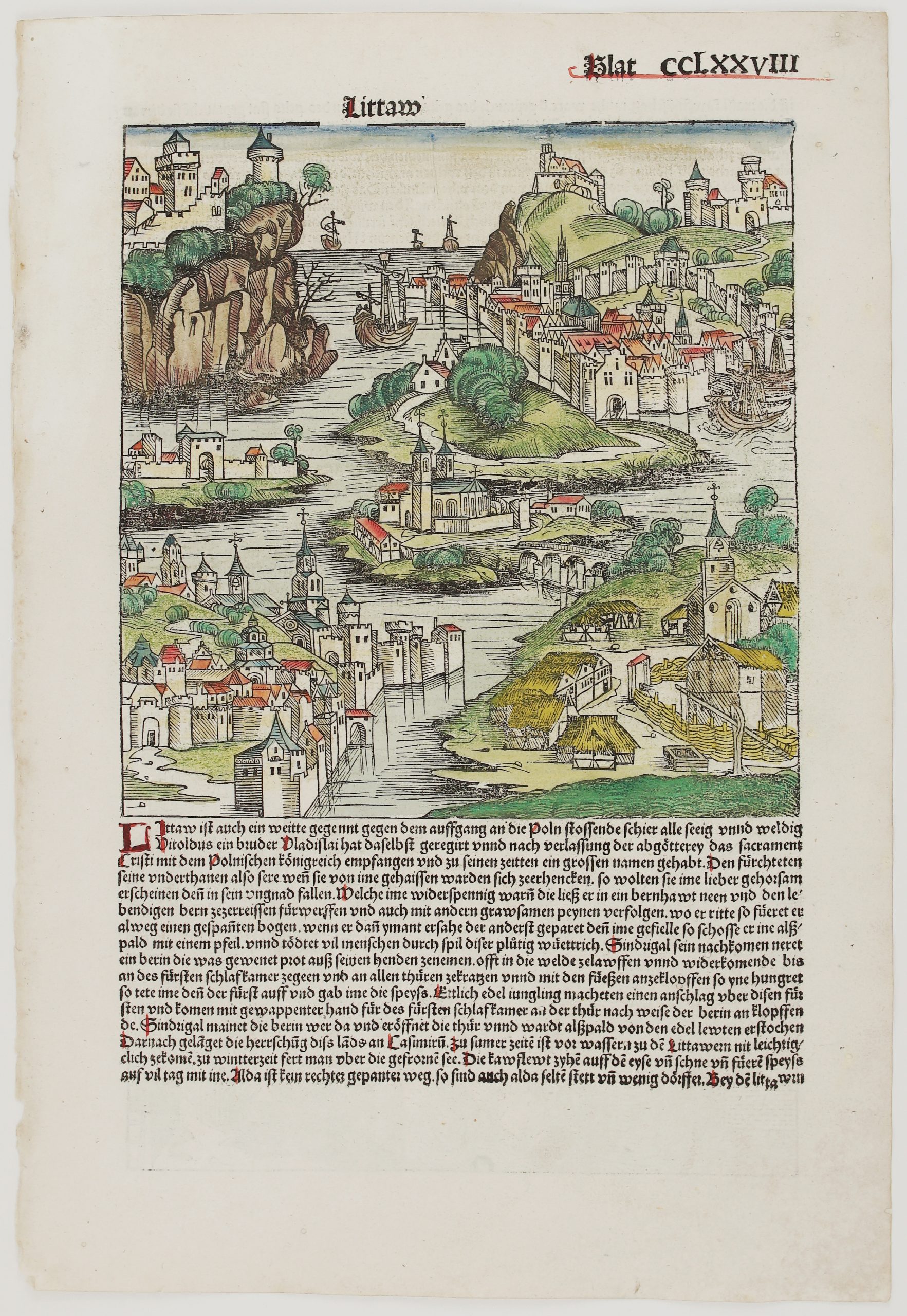
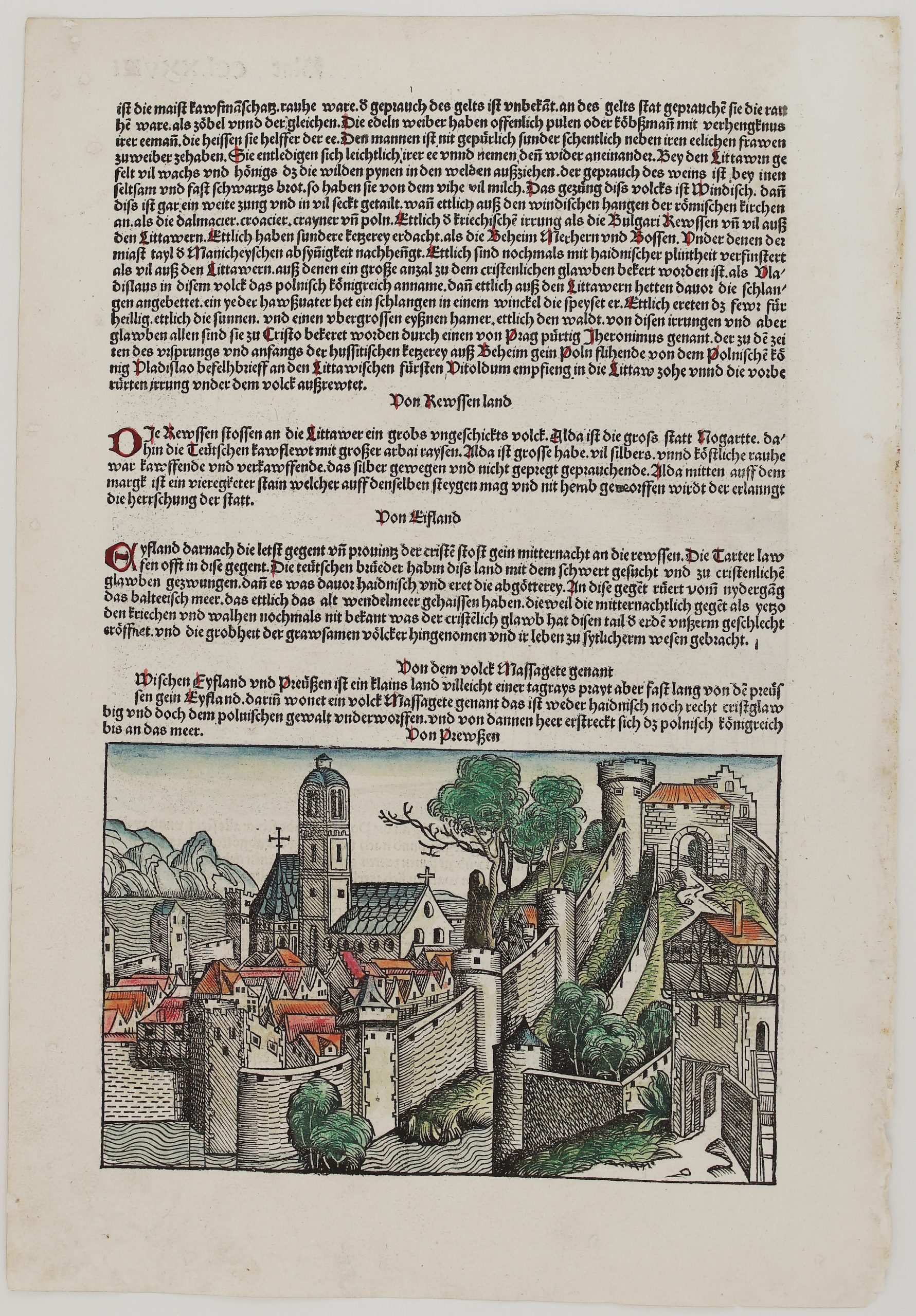
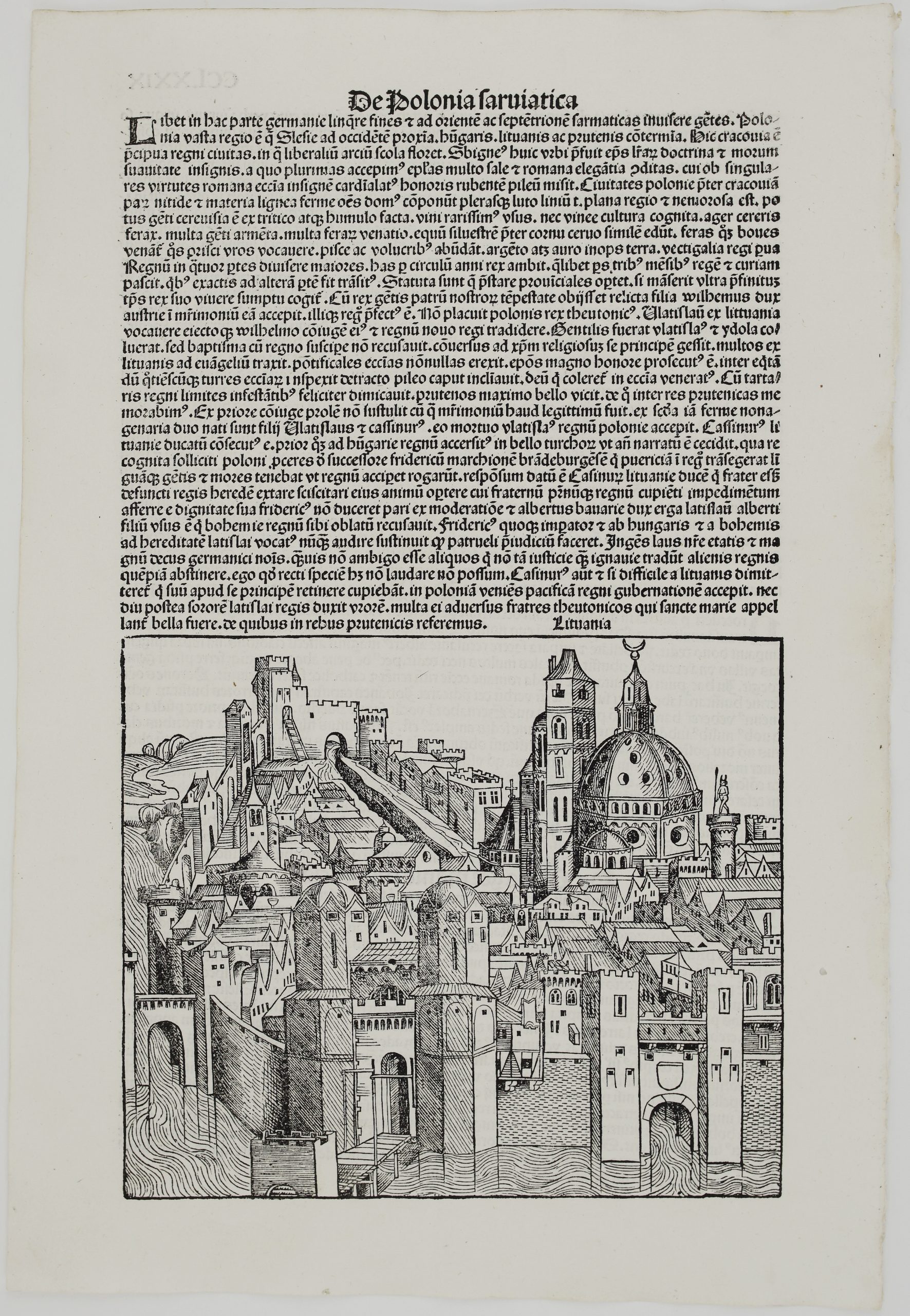
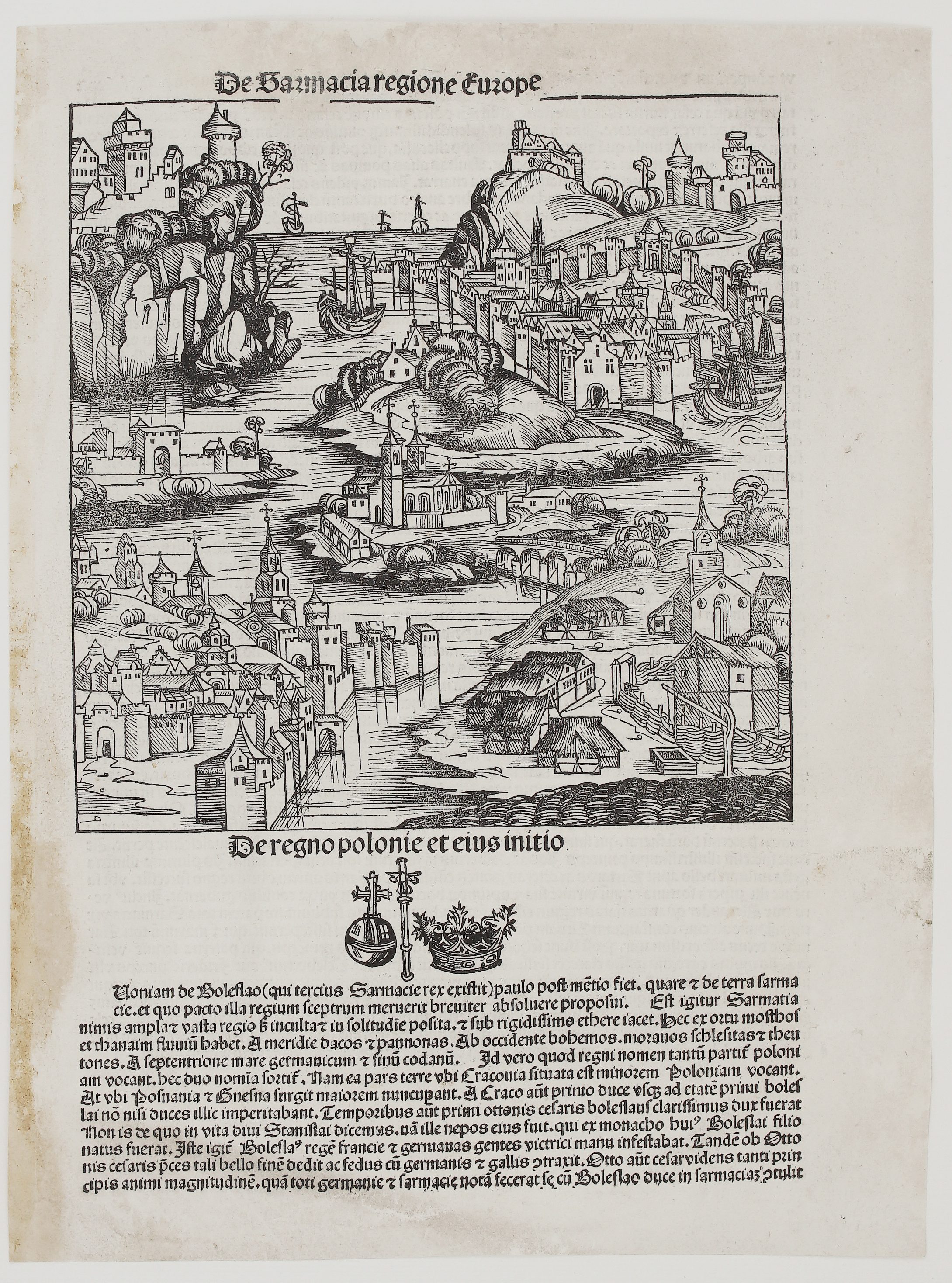
Woodcut side. Under the heading “De Sarmacia regione Europe” is a large woodcut from the workshop of Michael Wolgemut and Wilhelm Pleydenwurff. It shows an imaginary Sarmatian landscape from a bird’s-eye view: castles on rocky heights, walled towns and church towers along a winding river, a long bridge, and a sea with sailing ships. At lower right are wooden buildings with a well-sweep and a trough, perhaps a reference to the salt production described in the text.
Below, under the heading “De regno Polonie et eius initio”, a small woodcut of the royal insignia (orb, sceptre and crown) introduces the Latin text. It describes Sarmatia as a vast, thinly settled land under a harsh sky. Its borders are the Dnieper and the Don to the east, Hungary to the south, Bohemia, Moravia, Silesia and the Teutonic lands to the west, and the Baltic to the north. Kraków lies in Lesser Poland, Poznań and Gniezno in Greater Poland. From the legendary Duke Krak until Bolesław, only dukes ruled.
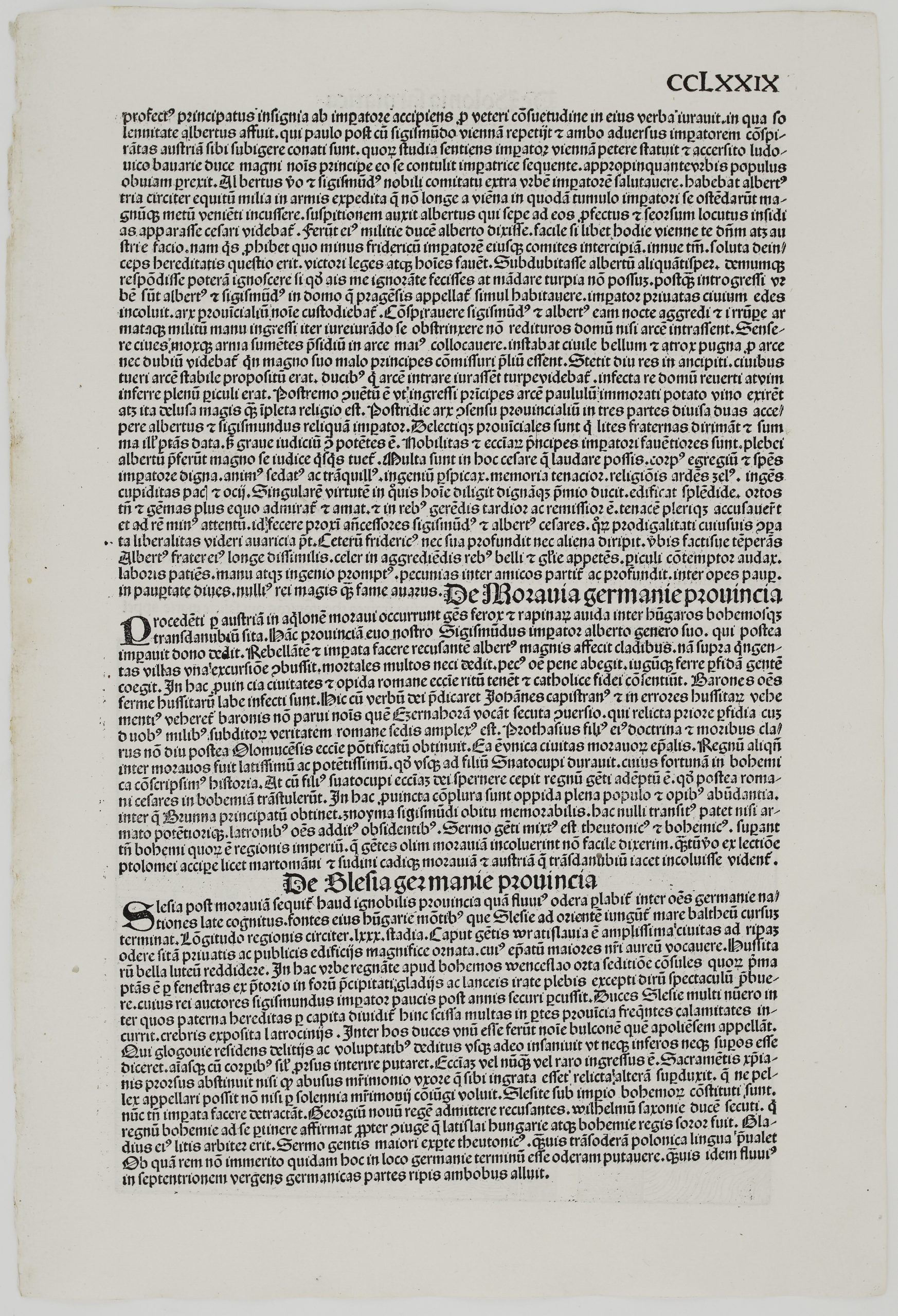
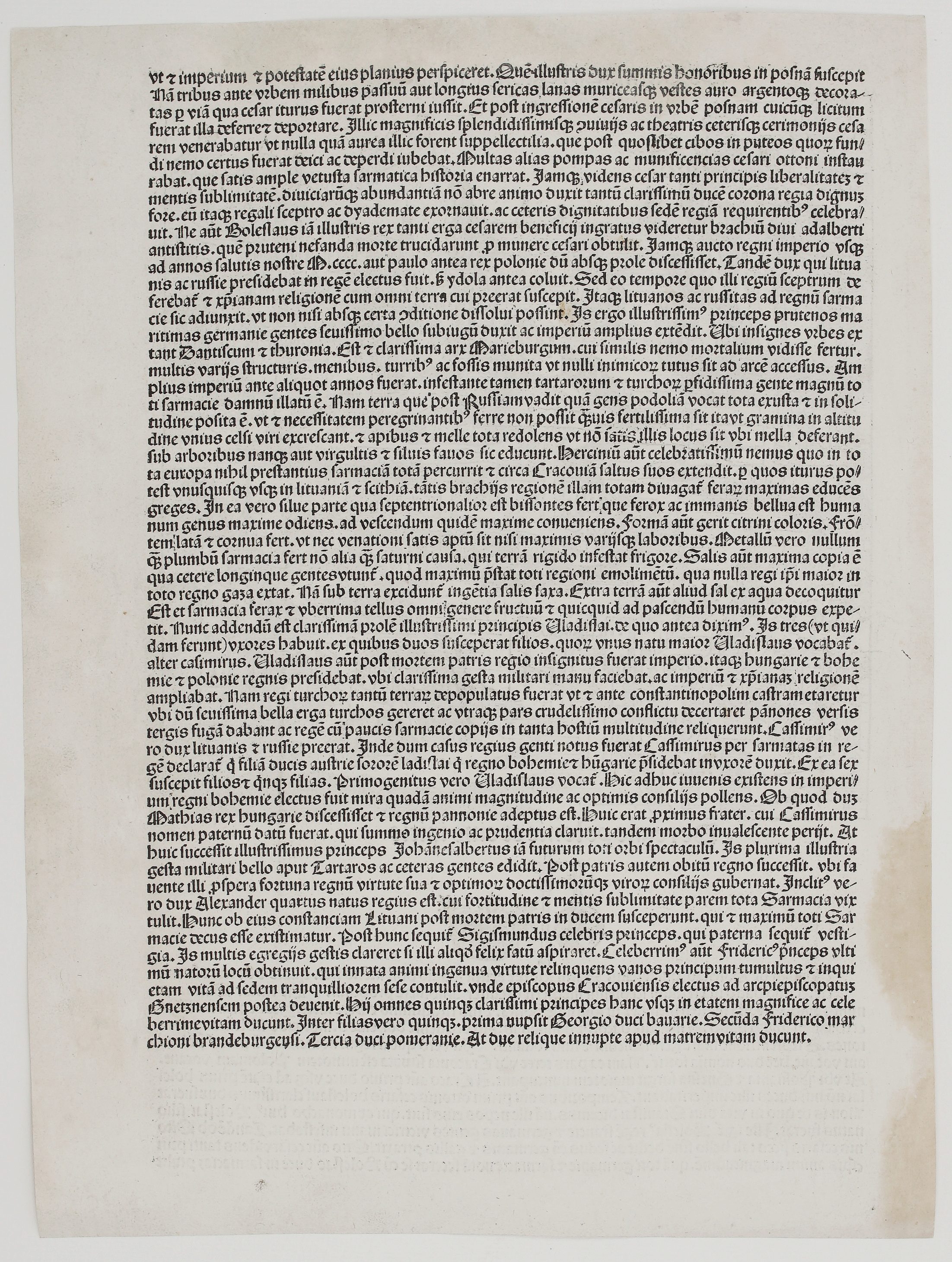
Text side. The text tells how Duke Bolesław received Emperor Otto in Poznań with great splendour. Silk cloth and robes decorated with gold and silver were spread along the road for three miles, and after every banquet the gold vessels were thrown into a well of unknown depth. Impressed, the emperor crowned Bolesław king, and Bolesław gave him the arm of St Adalbert, who had been killed by the Prussians. (Historically this was Otto III and Bolesław the Brave, at the Congress of Gniezno in the year 1000.)
Next comes the Lithuanian part of the story. The duke who ruled Lithuania and Ruthenia, Jogaila, was elected King of Poland. He accepted Christianity together with all his lands and joined Lithuania and Ruthenia to the Polish kingdom. He also defeated the Prussians, whose cities include Gdańsk and Toruń and the castle of Malbork, “the like of which no mortal is said to have seen”.
The text then describes the country itself. Podolia has been laid waste by Tatars and Turks, yet it is so fertile that grass grows as tall as a man and honey is found everywhere. The Hercynian forest runs across Sarmatia from Kraków to Lithuania and Scythia, and bison (“bisontes”) live in its northern part. There is no metal except lead, which the text blames on the cold planet Saturn. Salt, by contrast, is cut from the earth in huge blocks or boiled from brine, and it is the king’s greatest treasure.
The page ends with a portrait of the Jagiellonian dynasty, written at the time:
- Władysław III, King of Poland and Hungary, who fell fighting the Turks.
- Casimir IV, Grand Duke of Lithuania and later King of Poland, and his marriage to Elisabeth of Austria, with whom he had six sons and five daughters.
- Their sons: Vladislaus, King of Bohemia and Hungary; Casimir, “of great talent and prudence”, who died of illness (St Casimir, later patron saint of Lithuania); John Albert, the reigning King of Poland; Alexander, whom “the Lithuanians took as their duke after their father’s death” and who is called the greatest ornament of all Sarmatia; Sigismund; and Frederick, Bishop of Kraków and Archbishop of Gniezno.
- The daughters married to the Duke of Bavaria, the Margrave of Brandenburg and the Duke of Pomerania.
Written while all five brothers were still alive, the text shows the Jagiellonian family at the moment Alexander had just become Grand Duke of Lithuania (1492).
This is an important early printed source on the Polish-Lithuanian state, with references to Jogaila, St Casimir and Grand Duke Alexander.
The Nuremberg Chronicles was the first printed history of the known world with about 2000 woodcuts the most picturesque work of the early time of printing. It became one of the most popular books of the 15th. century. The woodblock cutters were Michael Wolgemut, teacher of Albrecht Dürer and his stepson Wilhelm Pleydenwurff. The printing was carried out under the supervision of the great scholar-printer Anton Koberger.
Cartographer: Hartmann Schedel (1440 – 1514)
Publisher: Anton Koberger
Sheet size: 39,5 x 29,5 cm
Year: 1493
Technique: wood block
Condition:
Good condition. Watermarked paper. Strong, dark impression with good margins. Light water staining and some spotting in the outer margin, not touching the woodcut or text; minor soiling at the edges.
This is an original antique map published in 1493 and not a modern copy or reprint
On your request I will provide a Certificate of Authenticity
In stock