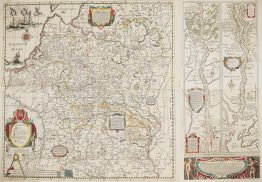
1493 – H. Schedel – Tabernacle of Moses
220 €
Page number: XXXIII
Description:
An original leaf from the first, Latin edition of Hartmann Schedel’s “Liber Chronicarum”, the famous Nuremberg Chronicle, printed in Nuremberg by Anton Koberger on 12 July 1493. The Chronicle is the most lavishly illustrated book of the 15th century, with 1,809 woodcut illustrations printed from 645 blocks. They were made in the workshop of Michael Wolgemut, the teacher of the young Albrecht Dürer, and his stepson Wilhelm Pleydenwurff. Folio XXXIII belongs to the “Third Age of the World” (Tercia etas mundi) and is devoted to the Tabernacle that Moses built in the desert. It is one of the most unusual leaves in the book, illustrated with almost technical drawings instead of the usual portraits and city views.
Recto (Folium XXXIII).
- The two altars. At the top are two versions of the altar of burnt offering: “Altare holocausti secundum latinos”, a plain altar as imagined in the Latin tradition, and “secundum hebreos”, the richly decorated Hebrew altar with its grating and burning offering.
- The priestly vestments. The text lists the four garments worn by all priests: linen breeches, a linen tunic, a girdle and a pointed linen cap. It adds the four that belonged to the high priest alone: the hyacinth-blue robe hung with bells and pomegranates, the sleeveless ephod, the breastplate set with twelve precious stones, and the golden plate inscribed with the Tetragrammaton, worn across the forehead “from ear to ear”.
- The high priest and the laver. A large woodcut shows the high priest in full vestments (“Figura summi sacerdotis in suis vestibus”). Beside him is the bronze laver in which the priests washed their hands and feet before entering the Tabernacle. It is drawn with a ring of round mirrors on its rim, because the text explains that it was made from the mirrors of the women who served at the entrance of the Tabernacle, or that mirrors were set around it so the priests could check their face and vestments for any stain.
- The Tabernacle’s dimensions. The page ends with the measurements of the Tabernacle. It was a house dedicated to God, closed on the north, south and west and open to the east so that it would be lit by the rising sun. It was 30 cubits long, 10 wide and 10 high, built of boards of acacia (shittim) wood.
Verso.
- Building diagrams. Under the heading “Figura pro tabulis et basibus terre infigendis” are construction drawings of the Tabernacle’s walls: the boards with their tenons and silver sockets, the corner boards, and one complete side wall shown both flat and in perspective with its bars. They look remarkably like an architect’s drawings.
- Veil, coverings and tax. The text describes the veil that divided the Holy Place from the Holy of Holies, and the four coverings: woven curtains, goats’ hair, rams’ skins dyed red, and blue skins. It also covers the half-shekel each Israelite paid towards the Tabernacle.
- The Tablets of the Law. Two woodcuts show the tablets with the Ten Commandments in Latin (“Ego dominus deus tuus. Non habebis deos alienos…”), divided in two different ways. “Secundum doctores aliquos” puts three commandments on the first tablet and seven on the second, following St Augustine. “Secundum doctores hebreos” puts five on each, as taught by Rabbi Solomon (Rashi). The text ends with Moses coming down from the mountain, seeing the golden calf and breaking the tablets.
A fascinating leaf for collectors of early printing, biblical history and Judaica, from the most famous illustrated book of the 15th century.
Artist: Hartmann Schedel (1440 – 1514)
Publisher: Anton Koberger
Sheet size: 31,3 x 43,8 cm
Year: 1493
Technique: wood block
Condition:
Very good. Strong impression on watermarked paper; a few small worm holes in the margins restored.
This is an original antique map published in 1493 and NOT a modern copy or reprint
On your request I will provide a Certificate of Authenticity
In stock