1628 – S. Munster – Von der Littaw
130 €
Title: “Von der Littaw.”
Description:
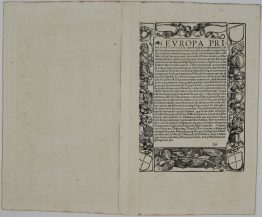
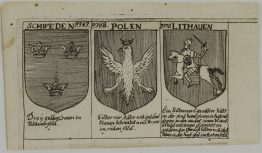
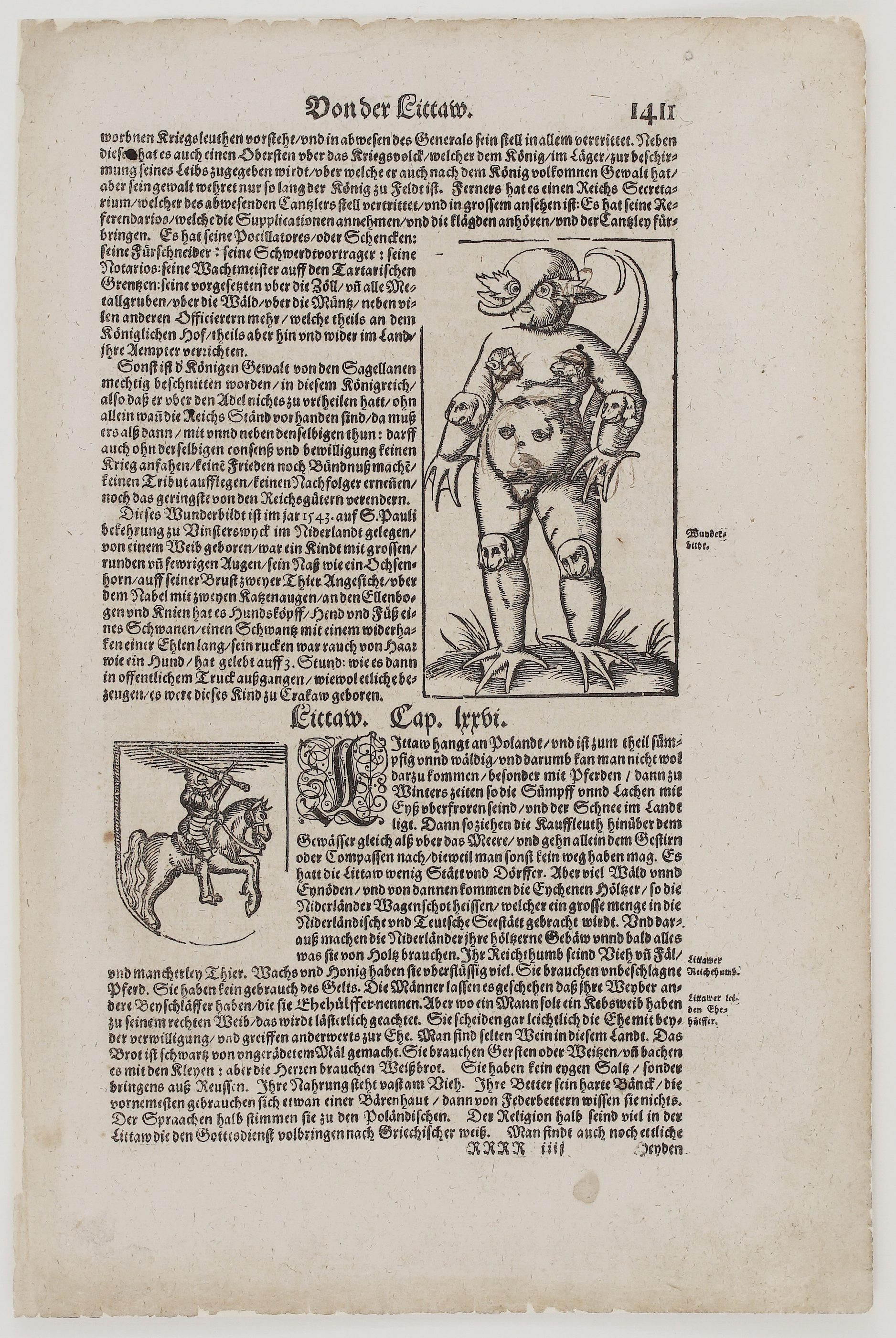
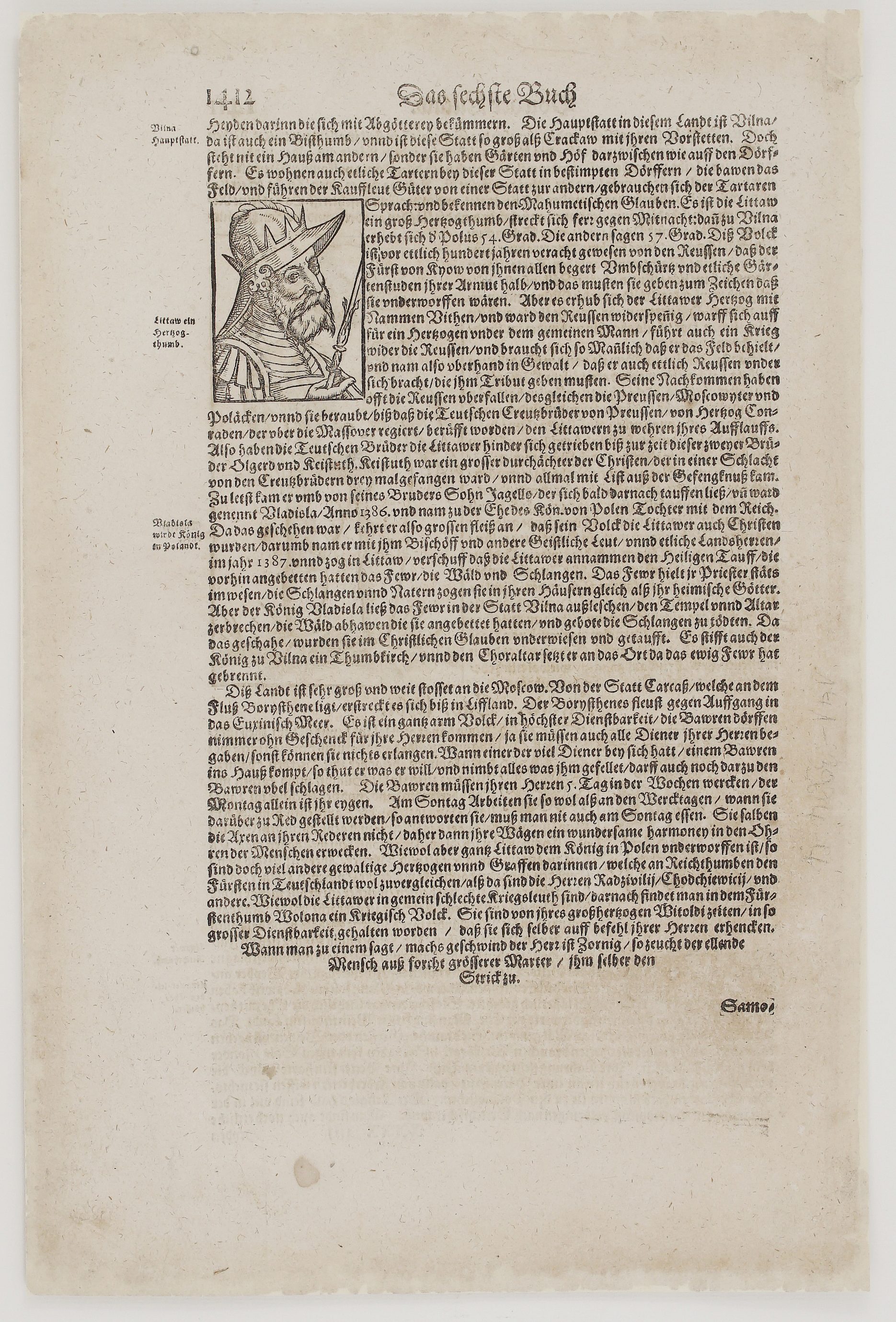
A decorative text leaf from the last and most extensive German edition of Sebastian Münster’s Cosmographia (Cosmographey), printed in Basel by Sebastian Henricpetri in 1628. Pages 1411–1412 of the sixth book carry the opening of Chapter 76, “Littaw”, Münster’s description of the Grand Duchy of Lithuania, with three woodcuts: the Lithuanian coat of arms (Vytis), the famous “Wunderbild” monster of 1543, and a portrait of a Lithuanian ruler.
Recto (p. 1411). The upper part closes Münster’s account of the Kingdom of Poland: the offices of the royal court and the limits on royal power. The king could not judge the nobility, declare war, make peace, levy taxes or name a successor without the consent of the Estates. Beside this text is the well-known woodcut of the “Wunderbild”, a monstrous child said to have been born in 1543 on the feast of the Conversion of St Paul. It had fiery eyes, a nose like an ox horn, animal faces on its chest, dog heads at the elbows and knees, swan’s feet and a hooked tail. Münster says it lived for three hours and adds that “some testify that this child was born in Kraków”. Known as the Monster of Kraków, it became one of the most widely reproduced images in 16th-century wonder literature.
Below begins the chapter on Lithuania. It opens with a large woodcut shield bearing the Vytis, an armoured knight with a raised sword on a rearing horse, and a decorative initial. Münster describes a country of marshes and forests that merchants could cross only in winter, when the swamps froze over. They found their way “by the stars or the compass”, as if at sea. He writes of the oak forests whose timber the Dutch called “Wagenschot” and shipped in great quantities to Dutch and German ports. He also lists Lithuania’s wealth in cattle, furs, wax and honey, its unshod horses and black bread, salt brought from Ruthenia, and hard benches for beds (only the nobility had a bearskin). The language, he notes, is close to Polish, many people follow the Greek rite, and some are still pagan. One curious passage describes the custom of the “Ehehülffer” (“marriage helpers”).
Verso (p. 1412). The text continues with Vilnius, “the capital of this land”. It is a bishop’s seat as large as Kraków with its suburbs, though its houses stand apart, with gardens and yards between them as in a village. Münster also mentions the Tatars living near the city, who kept their own language and the Muslim faith, and places Vilnius at 54 degrees of latitude. A short history of Lithuania follows:
Duke Vytenis (Vithen) throws off tribute to the Ruthenians.
Lithuania wars with the Teutonic Order.
Under the brothers Algirdas and Kęstutis, Kęstutis escapes three times from the Knights’ captivity.
Jogaila is baptised as Władysław in 1386 and marries the Polish queen.
In the Christianisation of 1387, the sacred fire in Vilnius is put out, the holy groves are cut down, and the cathedral is founded with its high altar on the spot where the eternal fire had burned.
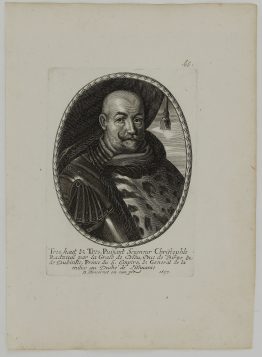
The page ends with the hard lot of the Lithuanian peasants, who worked five days a week for their lord. Münster adds that they never greased their cart axles, so the wagons made “a wondrous harmony” in people’s ears. He also names the great magnate families of Radziwiłł and Chodkiewicz. The text is illustrated with a woodcut portrait of a Lithuanian ruler in armour, crowned hat and sceptre.
The woodcut comes from the German edition, woodcut book of Sebastian Münster’s Cosmography, titled “Cosmographey oder beschreibung aller Länder…”, published by Sebastian Henricpetri in Basel, 1628.
Cartographer: Sebastian Munster (1488 – 1552)
Publisher: Sebastian Henricpetri
Book size: 36.7 x 24.3 cm
Year: 1628
Technique: woodcut
Condition:
Good condition. Strong impression of text and woodcuts, wide margins. Light age toning and minor spotting, mostly marginal.
This is an original antique woodcut published in 1628 and NOT a modern copy or reprint
On your request I will provide a Certificate of Authenticity
In stock